Sunday, August 15, 2021

Last Stop Before Michigan

 It was a long 120 mile drive to our next campground in Kewaunee Wisconsin. 

This campground appears to have been an old KOA campground. The place was an ok place for a short stay. The site are tight, with close social area between sites. There were a couple of places to visit around town.

A short drive back into town we visited the worlds largest grandfather clock.

The clock was built in 1976 to celebrate the country's bi-centennial. The original location was at the Svoboda furniture factory, who built the clock. Over time the clock looked a little worn, the clock was dismantled in 2013, refurbished, and erected in 2014 in its current location.

After our 5 minutes looking at the clock we took a walk over to a tug boat on display. The tub boat was built in 1943 at the Jacobsen Shipyard in Oyster Bay, New York. Originally christened Major Wilbur Fr. Browder, and saw service in WWII. The tug towed ammunition barges across the English Channel during the D-Day invasion at Normandy, France.

In 1947 the tug came home and was re-assigned to Kewaunee, and renamed "Ludington".

For a small donation, visitors can take a self-guided tour of the boat. We started the tour in the galley, from there we moved to the engine room.

This tug has an 8-cylinder, 1200 horsepower engine. The engine was the demise of the tug. The proper way for a tug to change directions, was to come to a complete stop, then reverse direction. One day the procedure was not followed, and the engine was damaged beyond repair.

It took special people to operate the electrical switchboard on these boats. Old timers will remember the term "dead man" switches, and this boat is a prime example.

This boat also ran on DC current, in other words, batteries.

The engine room was two levels, lower level contains most of the engineering workings: compressors, winch, generators, etc.
There were quarters for the crew, not exactly suites for their enjoyment, but enough to get some rest.
The next priority area involves navigation, and the bridge.
You cannot get to the bridge, except through the navigators station.
This tug functioned into the the years where electronics made a contribution to navigation. The green piece of equipment told the bridge watch what was around them... things like land, shallow water, and other vessels. Back down to the main deck and off the boat.

Kewaunee's waterfront has a bit of history itself. Economics, geography, and transportation technology posed a unique issue to the industrial world. The three major railroad companies came together and created a railcar ferry system on Lake Michigan. The Kewaunee Railcar Service made its first trip in 1892, departed Frankfort Michigan, headed for Kewaunee Wisconsin. This first trip carried four cars containing coal; the next day 22 cars left Kewaunee to points east. 1990 the service made its final run.

Continuing our tour of the waterfront, we headed to the lighthouse. A building can be seen across the water, 200 yards maybe, is the Life Saving Station, Kewaunee. The station was constructed in 1893 due to maritime mishaps that occurred in 1886, Lake Michigan got rough because of a storm, sinking the Emerald and Dickenson schooner barges. With the sinkings came loss of life. Life Saving Stations were location up and down the shore of Lake Michigan, manned with personnel and row boats. In 1915 U.S. Life Saving Service and Revenue Cutter Service combined to form the U.S. Coast Guard. The Kewaunee station operated until 1947, when it was closed.


Continuing down the pier we walked around the Kewaunee Pierhead Lighthouse.

This is what the lighthouse looks like today, in 1923 it looked a little different:


The lighthouse was not open for us to climb. The pier is close to 1,000 yards long.
Looking from the lighthouse back to shore.

We made our way back to shore and had lunch before we went to visit the Jailhouse Museum.

The view from our table. The trees to the right are hiding the Life Saving Station. After lunch we climbed back into the truck and headed for the museum.

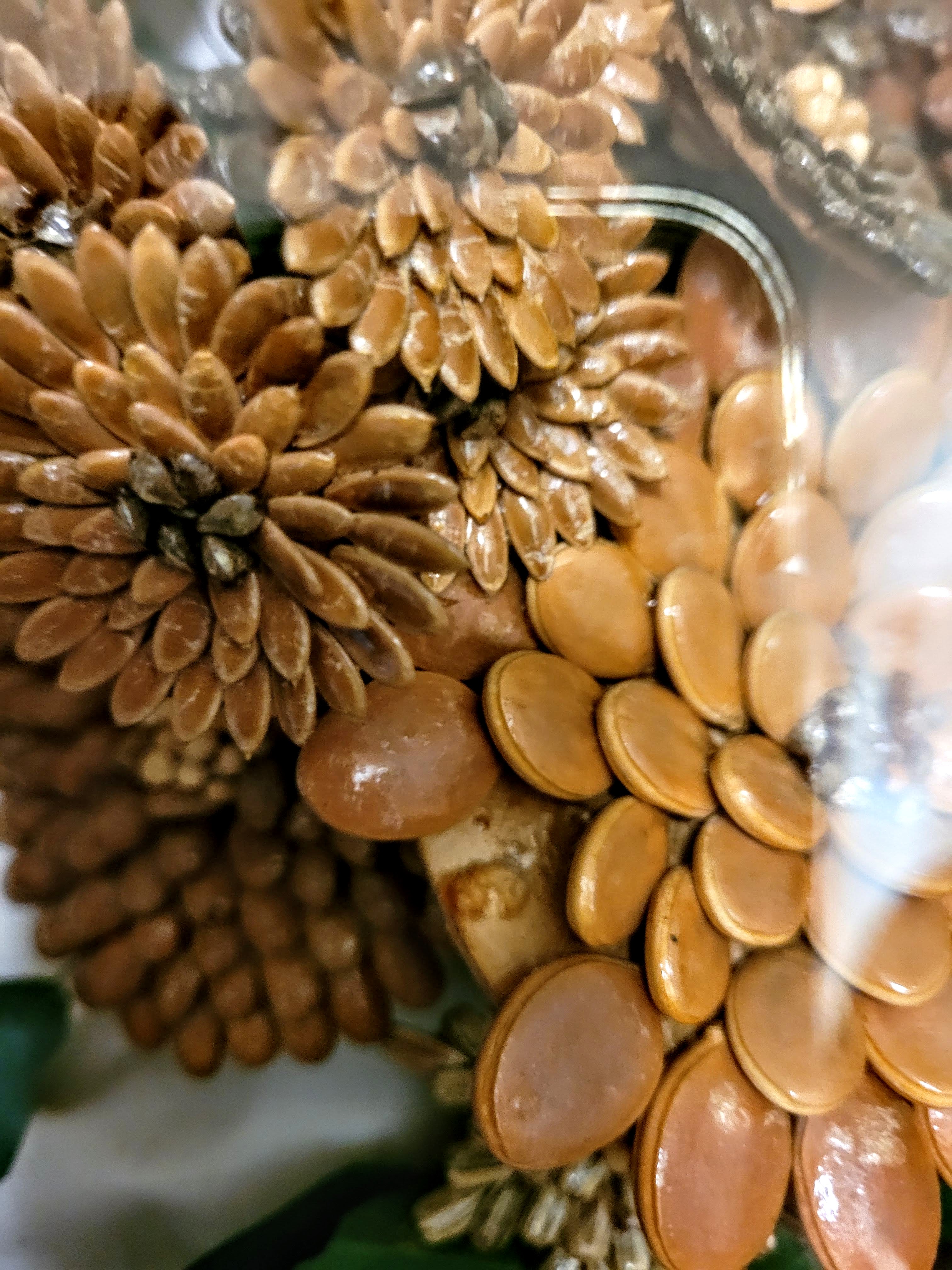
The name Jailhouse Museum is a bit of a misnomer, it is a museum located in the old jailhouse. Like many small town museums, it shows the history of the region. The basement was history of farming in the region, the second floor contained the actual jail cells displaying more culture of the region, and the third floor was... you guessed, more region history and culture. The museum was still interesting. Carol and I found a particular picture intriguing, it was made from nuts and seeds.
Again we have seen another small town with big regional history. 

Next stop, Michigan

Flyin' Low to Wisconsin

 Our journey took us on a whirlwind tour through Nebraska and Iowa, to Wisconsin. Travlin' through all three states one sees a lot of corn growing. It is my understanding that most of the corn grown in Iowa is to feed livestock. 

Most of the stops were overnighters, with the exception of Gothenberg (pronounced Got-ten-berg).

Front Yard
Back Yard

The park was an older park on the lake. 

We headed into town for sightseeing. We hit the big attraction in town... the Sod House Museum. The museum portion itself is really a story of the local life around the area.
The real story is behind the building... a buffalo, Indian, and older home.
You might notice that the two sculptures are made of barbed wire, most of it without barbs.
The sod walls were about 18 inches thick, with a dirt floor.

After our long tour of the Sod House Museum we went to lunch, then visited an original Pony Express station.
The original station was a two story structure, however, when it was moved to its current location they did not construct the lower floor.


The next morning we continued our trek east. A few more nights in Nebraska, and we landed in Iowa.

The road was a rough one at times, which was obvious when we stopped for the night at a Corp of Engineering park. From the outside everything looked good.
Let's take a look inside...
First time this had happened. After this event we decided to close the leaf on the table when traveling.

As a member of "Harvest Host" we have the opportunity to stay at wineries, breweries, alpaca ranches, and if we chose the golf package, golf courses.  This trip we stayed another winery:

 The camping was down at their warehouse, and provided 50A service, good enough to run the air conditioner. From the warehouse it is a gentle uphill walk to the tasting room.

On the way up to the tasting room we met the welcoming committee, providing directions.
The grapevines we walked past were young, but they had grapes on them.
We had a light lunch before doing some wine tasting. The winery encourages responsibility when drinking.
Where could you find yourself on the eye chart?

From the winery we got back on the road and arrived at our new temporary home at Breezy Hill in Fond du Lac. This was year number three at this campground. The campground has a lot to offer to the children. The campground has two fishing ponds, a swimming pond, swimming pool, air pillow, playground, and an arcade. Yes, adults can play too.

Carol and our daughter-in-law took a trip, between rain storms, to the local creamery to look at sunflowers. The flowers were non-seed producing.
The creamery plants this field every year, and the donations from visitors goes to supporting flights to Washington D.C. for veterans. Oh yea, the creamery has great ice cream too.

I mentioned rain a little earlier because it made a major impact for a couple of days. We had the awning out, with a new shade screen we bought for it, took a small beating, even though they were secured down. The wind at times kicked up to speeds close to 70 MPH, steadily blowing around 25 MPH. With those winds our canopy couldn't hang, and one side collapsed in.
We were able to temporarily able to fix it, until it was thrown away. In between the rain squalls we did some sightseeing.

One of the drives we took encompassed the the shores Lake Winnebago... unfortunately most of the shoreline is private, with few roads accessing it. Their were a few beaches, mostly private. We drove all the way around the lake to see a lighthouse in Fond du Lac, which we could have stopped at before we even started the trip.
The lighthouse was built by the unemployed community during the "Great Depression". The plan were donated by an architect in 1932. The 60 foot tall lighthouse built in Lighthouse Park, and was completed in 1933. Visitors can climb to the lookout deck. 

In between the rain we had some nice sunsets.

The second photo was taken after a big rain, at sunset.

With the kids gone and adventures at an end, it was time to prepare for our next leg, which would be our last stop in Wisconsin.