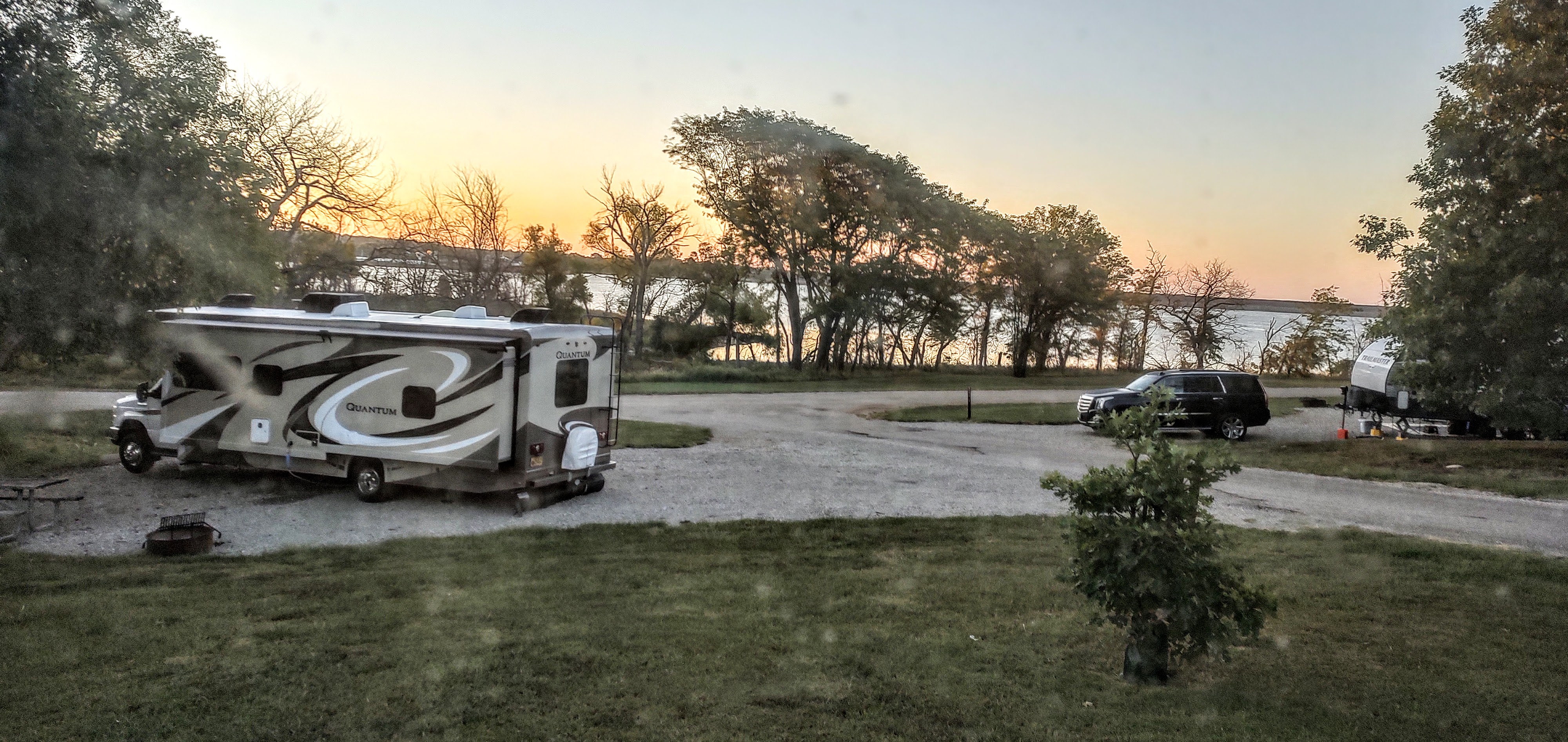
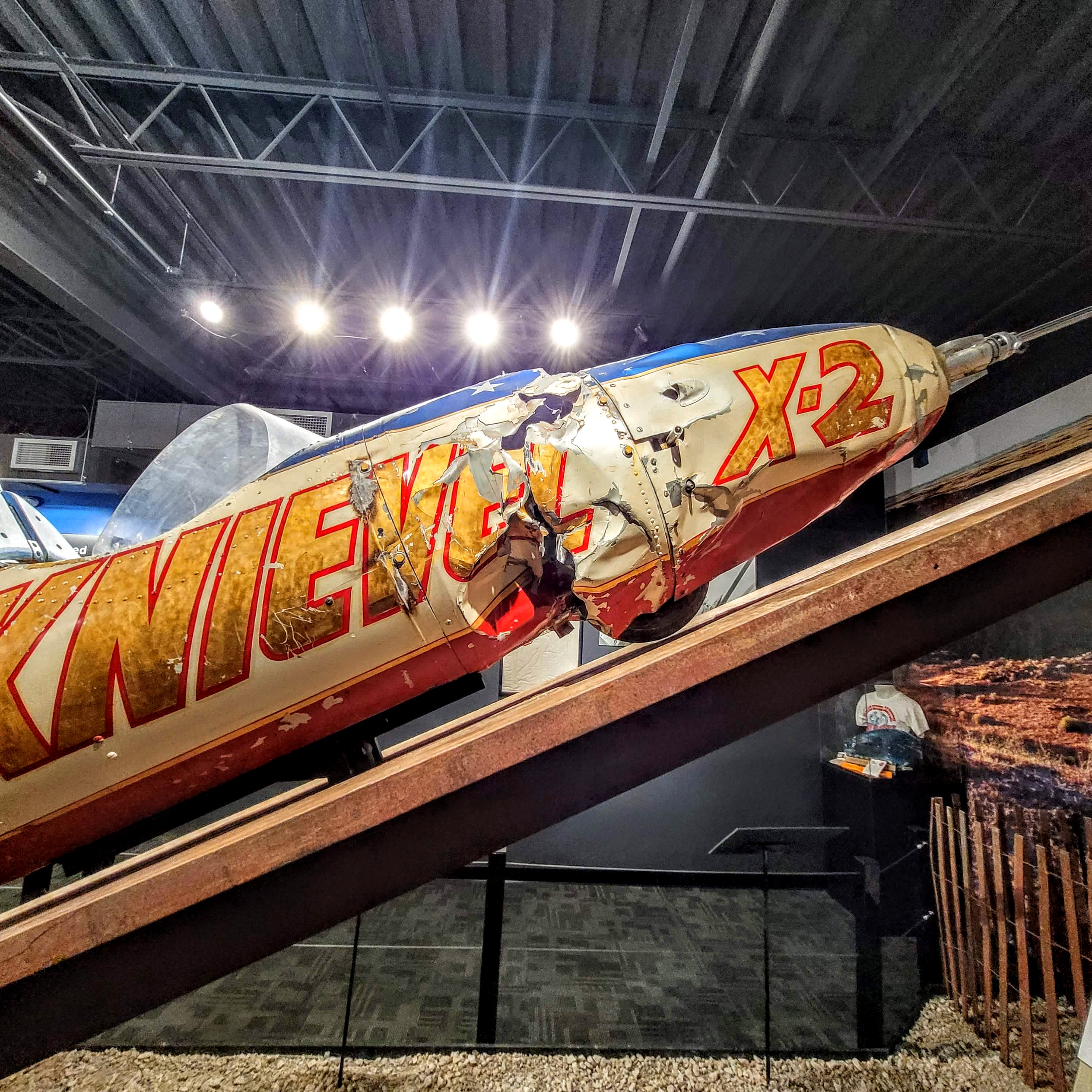
Happy anniversary to us... #36. We decided to go out and celebrate once we settled in for the stay. There isn't much in Goddard, so we headed into Wichita... a whopping 10 miles away. We ended up at one of our favorite places, a steakhouse, this one is called 6S. There is an advantage to liking an earlier dinner... no reservations required... it was great.


The dessert was a butter cake, scoop of ice cream, and the words "Happy Anniversary". Fireworks comes with the dessert.
There a few attractions to see in downtown Wichita... so off we go. Our destination for this day was the Old Cowtown Museum. The museum is not your ordinary walk through a building, it is a walk through 40 buildings from the late 1800s. The starting point of the self-guided tour begins with the Native American Indians.

Eastern Kansas was the home of the Osage Nation. This area was a trading hub for the Indian nations because of the environment. What was to become Wichita is located at the fork of the Little Arkansas and Arkansas rivers. What was once the home of the Osage Nation, became home to almost 30 other Indian nations that were moved from the east, thanks to the Indian Removal Act of 1830. Some of those nations included: Cherokee, Chippewa, Delaware, Iroquois, Sac and Fox, and Shawnee. Most of the nations that were moved to eastern Kansas were later moved to Oklahoma, by 1854... and put on reservations. Sadly, the western Kansas nomadic tribes that followed the buffalo, moved to Oklahoma, again thanks to a treaty, the 1867 Medicine Lodge Treaty.
Besides the Native American Indians, Europeans came into the area to trap, hunt, fish, and trade. Some of the first Europeans considered this region "a desert" region, but as time went on, it was claimed to be the "breadbasket" of America... and all Indians were moved to Oklahoma Territory.
Time to look at the growing of Wichita. There are two names that stand out regarding Wichita, Jesse Chisholm, and J.R. Mead. Meet Jesse Chisholm, a freighter, trader, guide, and interpreter... and considered the "Prairie Ambassador". Jesse was born 1805, in Tennessee, and is of Scottish-Cherokee heritage. By 1820 he was part of the Cherokee Nation in Indian Territory (Oklahoma), living near Fort Gibson.

In his youth he was part of a gold seeking expedition along the Arkansas River, in the area that is now Wichita; he helped blaze a trail between Fort Gibson and Fort Towson; took part in an expedition that made first official contact with Comanche, Kiowa, and the Wichita.
Jesse was fluent in fourteen dialects, which helped in his trading ventures, and treaty negotiations. One of those treaty negotiations took him to Washington D.C., where he was the interpreter for President Polk.
After the Civil War Jesse Chisholm spoke with a friend, Black Beaver, who was a guide for the military during the war, regarding a route from Texas ranches to the Kansas rail spur. The route that Black Beaver recommended was the same route he guided the military on... the one that is now known as the "Chisholm Trail". In 1868 Jesse Chisholm died, and was buried in Geary, Oklahoma.
This gentleman was J.R. Mead, a hunter, trader, naturalist, philanthropist, and entrepreneur. He came to the

In 1868 James was elected to the state legislature, and was a great influence in naming of Wichita, after the Wichita Indians.
Both of these men were considered honest men in their dealings with others.
* https://www.washburn.edu/reference/cks/mapping/mead.
* https://www.okhistory.org/publications/enc/entry.php?entry=CH067 (easier to type in Jesse Chisholm).
Old Cowtown is an assortment of buildings from the region, and represents what it may have looked like in the late 1800s. Cowtown was the junction for trading furs from the Indians, and manufactured goods from the white man in the region. You may be wondering why I keep referring to this town as Cowtown... it is because that was what Wichita was originally considered before the farmers arrived to harvest the land.


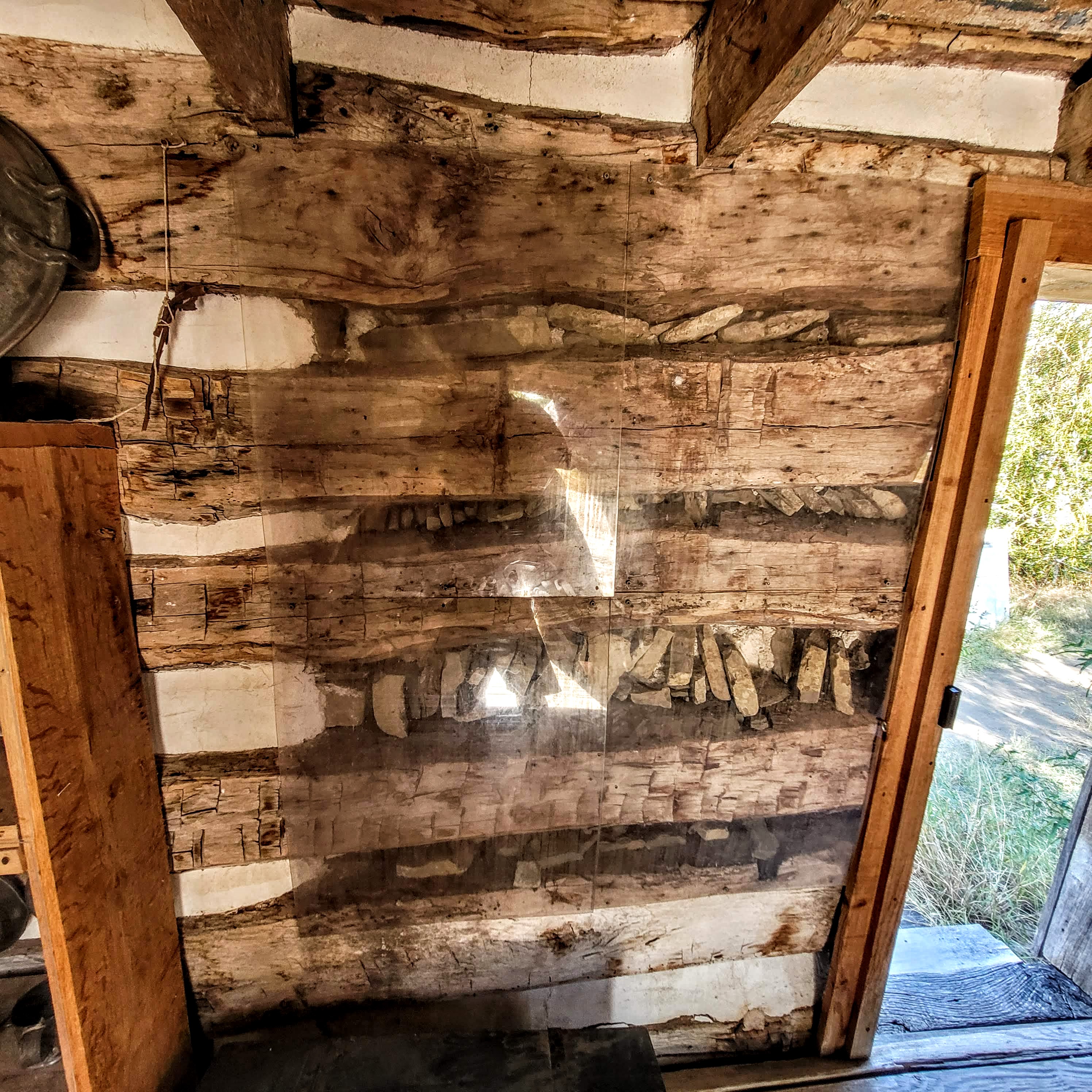
The third photo provides a look into how a frontier cabin may have been built. Because trees were not always nice and straight, a lot of filler material was required, and in the case of this cabin, wood and small stones were used before the mud coating. Cabins this size could have as many as six people living in them.
Wichita Fun Fact: Pizza Hut was founded in 1958 by Dan and Frank Carney. Pizza Hut later merged with PepsiCo in 1977.
Before walking the main street of Cowtown visitors can stop in the Indoctrination Center to watch a short video about Wichita. The center also exhibits information about the buildings in the town. Beside businesses there are several residences, and a farm. Our first building was the church. Apparently there were several denominations, due to the diversity of the region.


This church started out as a Presbyterian church, built in 1870. This congregation started with 13 members, meeting in a dugout in he livery stable. The congregation found it unacceptable meeting there, and raised $1,500.00 for this wood structure building. Think like you were living in the 1870s, and you need materials to build the church. Unlike today, these folks had to travel days to get the materials they needed. When the congregation grew, the church was sold to the Catholics, and they eventually sold it to someone that turned it into a boarding house.
Wichita Fun Fact: By 1876 cattle drives had ended, Wyatt Earp ends his service as Peace Officer, and the county population is around 13,000 residents.
Wichita Fun Fact: It was 1874, and a grasshopper plague descends on Sedgwick County. All field crops, gardens, and clothes hanging on the line were eaten.


The house was the home of the only female school teacher, Rebecca Duff. She arrived in Wichita, from Illinois, in 1878. Her single status only lasted until 1880, when she married Charles Philip, a Wells Fargo representative. After their marriage she assumed the role of wife and mother, raising their four children.
 These buildings represent the growing Cowtown into the agricultural city of Wichita. The Implement Company represented the growing business of farming
 The livery stable represented the world of the cow punchers who drove their herds to the stockyard in Wichita for shipment by rail to points elsewhere. The livery stable also served other residents and visitors to the town.


The railroad was not only for shipping beef cattle, it provided transportation for human cattle as well.

Wichita getting the railroad was a political maneuver. The politicians of Wichita offered to trade their votes on a bond issue with Newton, KS, giving Newton their own county seat. 1872 signaled the arrival of the Atchison Topeka and Santa Fe railroad. The local newspaper proclaimed, "we are now within the bounds of civilization".


We strolled down a dusty road to a farm that was typical of the era. 

As a woodworker coming into a new era, this would have been like the coming out for cordless tools. What you are looking at is a table saw driven by horse power. The table saw would have been in front of the horse treadmill, with a leather belt running between them.


This is a modest home, with the 2nd floor containing the bedrooms, which were not accessible to visitors. From the house we moved out to the barn area, where they actually had a very large cow in one of the pens. Going inside the barn brought back memories of the days I owned horses, and the sweet smell of hay. I still remember the days of bucking (loading) hay and getting home to unload it. Fortunately the bales I was moving around didn't weigh more than 50 pounds, these were probably somewhere around 4-500 pounds.


As we were leaving the farm they had a exhibit regarding sweet sorghum. When Carol and I first  saw this crop, it looked like short corn stalks with a funky plume on top. Come to find out, its a big crop in Kansas.

Remember I mentioned that they thought Kansas was a desert, well, sorghum was found to handle this "arid" climate very well. Sorghum is not a mini-corn plant, it is really in the grass family. It wasn't really cultivated in America until around 1853, and predominantly in the southern Appalachian region.
So how did Kansas get to growing sorghum? Entering the story of sorghum farming is the Civil War. You see, trade with the south was cut off, which meant no sugar... oh what to do! Take 2-3 pounds of sorghum seeds and plant an acre of land, the cane stalks growing to heights of 8-12 feet, and now you have the start of sugar. Here in Kansas the crop isn't taller than four feet.
So how did they make their sugar, the same way other producers do, they press out the juice and cook it.

10 gallons of juice produces 1 gallon of syrup. As a sweetener, it is used in making Jam, jellies, in cakes, pies, candies, and cookies. Kids and adults will skin a stalk back and chew on it, just like sugar cane. Like sugar cane, too much chewing will cause it to act like a laxative... if you get my drift. People today interchangeably use the the terms molasses and sorghum to mean the same sweetener, but that is incorrect... molasses comes from sugar cane, sorghum is from sorghum plant.
Advantages of a sorghum crop, one was the opportunity to use it for bartering. Besides it being a sweetener, it is also used as fodder for animals. Here is an example of how barter could have worked. A person gets sick, goes to the doctor, and after treatment the doctor is paid in sorghum. The doctor in turn pays for the care of his horse in sorghum to the livery operator.

Time to head into town for some shopping.
The first building we came to exhibits dolls, yes dolls. 

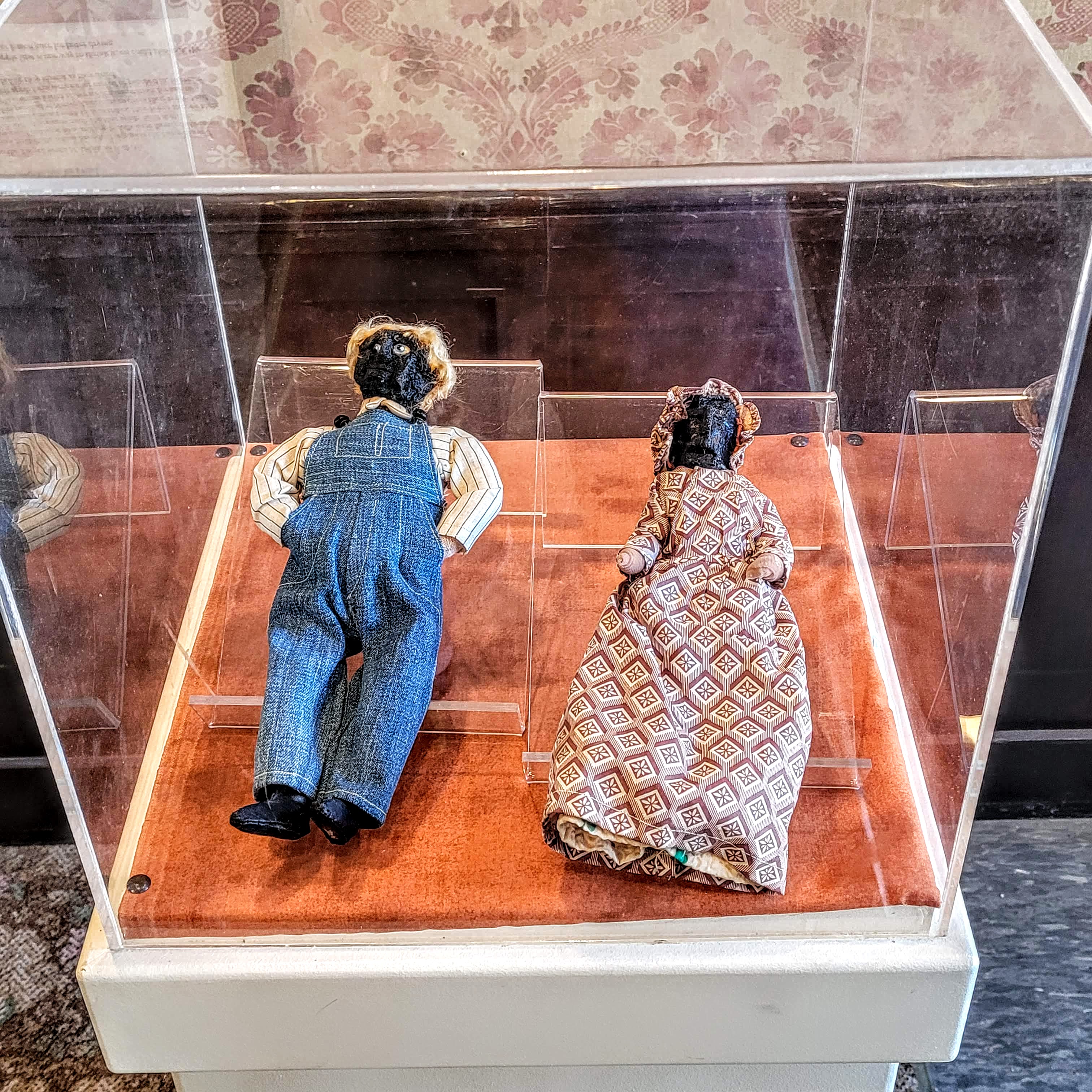
 The dolls an display were made from porcelain, bisque, and apples.
 Apple faces like this are in the black couple. The faces were not carved until the apple was dried. There are two ways to dry the apple, either dehydrate the apple, or soak in salt water, or lemon juice.



The next turn found us in front of the blacksmith shop. 

Blacksmithing was a special talent, just like it is today... except there were no power tools. As a woodworker, I was intrigued with the repair of the wagon wheel. It is hard to see in the photo, but there is no pattern to putting it together, which meant that they cut the wood, drilled holes for the spokes, and build a metal ring around the hub.


Blacksmithing was a special talent, just like it is today... except there were no power tools. As a woodworker, I was intrigued with the repair of the wagon wheel. It is hard to see in the photo, but there is no pattern to putting it together, which meant that they cut the wood, drilled holes for the spokes, and build a metal ring around the hub.
Strolling down the street we stopped into the sheriff's office. One of the first signs a visitor might have seen entering the town was a city ordnance to turn in any weapons to the sheriff's office.


When the visitor came into the office, they received a tag, and their weapon was locked up, until they turned the tag back in. Now all people followed directions well, and they had to pay the price for their actions. Here are the steep costs for disobedience:  Remember I said Wyatt Earp was a peace officer, and later left Wichita... it wasn't necessarily on good terms. In 1876, Earp had gotten in a scuffle with a fellow peace officer, so the new marshal fired Earp... "action unbecoming of a peace officer". He left Wichita for Dodge City, and by 1879, he was working in Tombstone, Arizona.

Wandering across the street, we headed over to the saloon for lunch. On our way past the hotel we spotted the opportunity to go bowling.


The saloon was built in 1885, an was located in El Paso, now Derby, Kansas. It was moved to its current site in 1966, and restored to represent Fritz Snitzler's Saloon, of the 1870s.
After our gorging on hot dogs and chips, we continued out to journey through the rest of the town. Next stop is the accommodations for those not  behaving. These are the accommodations for the drunk and disorderly, and weapon violators.
 The window is one of the two for each cell, and my guess is that the one in the hall provided a light to the cells at night. There is another cell that has a solid wooden door, with a small window in the door, this cell is for the troublemaker requiring isolation. This is the actual jail that sat at Market and 2nd Streets.


I never really paid attention to buying clothing in the late 1800s.


The lighter color building is the Millinery, clothing for the woman in town, and the Dry Good Store made clothes available for men.
Down the street one could find a drugstore that could sell them any remedy for any ailment. The drug store exhibited here is no different.


The last photo had us wondering which prescription the whiskey was used for. Some cities were coming into the future, offering the soda fountain. The first record of a soda fountain in Wichita was in 1871, when Ola Martinson bought one for his bakery business. Soda fountains were becoming a mainstay in drugstores too. An increase in soda fountains and soda water in Kansas happened because of a prohibition law Kansas passed in 1880.


In some towns you could find the doctor or dentist above the drugstore.


Depending on which door you entered from the waiting room, determined what your need was.
What do you think your prescription would have been if you had rheumatism... that would be oil of geese, wolves, bears, or polecats. Suffering from consumption... fried heart of rattlesnake, or skunk meat. Only hives... tea from the scrapings of stallions hooves. Heaven forbid you have smallpox... carry an onion in your pocket. What about shingles... hot blood of a chicken. Try keeping some of those items in your medicine cabinet.


This general store would have been similar to the one that Mr. Mead would have established when he arrived.


With all this livin', death isn't far behind. Services weren't fancy, but they were respectful. From the funeral parlor, the deceased would be carried to the outskirts of town for burial.
This town was phenomenal, and we would highly recommend spending a day in this town.
You can see a little more at: https://www.oldcowtown.org.
BACK HOME ON A BREAK
Wichita was a time for looking at the past. As a child my parents would let me come to Kansas to visit my grandmother, here in Wichita. In an earlier blog I mentioned my trip by train, another year was a plane ride. We finally moved to Wichita... and this is where the story begins today.
I was in the sixth grade when we decided to move to Kansas, and I had the opportunity of learning about public schools. We moved into a house not too far from the school, and I was able to walk to school.
 Our house was on Chautauqua Street. My fondest memories of this house, making my own fried bologna sandwiches for lunch, and the handicap ramp into the basement. The house was a different color in my day.
 Here it is, my sixth grade school, Sunnyside Elementary. Today the school is a historic building made into an apartment complex. I could not walk inside, they have access control.


After I finished elementary school, I moved on to junior high school. Before I started school, we moved to another home, a bit further away.
 When we lived here 55 years ago, there was an abandoned two-story duplex on that empty lot. Being the fire lover I am, I tried to burn the duplex's garage down... unintentionally. I was playing with my cars, and decided to have a fiery car crash. I doused my cars with lighter fluid, and lit them on fire... I didn't pay attention to all the dead grass laying on the floor, and it started to ignite. I did put the fire out without any damage to the structure. Another memory I have pertains to that driveway. One year we had snow and the driveway was icy. My dad tried to back our car down the driveway, and it slid into the retaining wall, leaving a deep crunch down the side of the car. During the summer I would walk to downtown Wichita, and I'm guessing it was somewhere around seven miles one way. The junior high and high school are somewhere else these days.


All this reminiscing built an appetite, so off we went looking for food. We found the Wichita Brewing Company (WBC).

This whole area didn't exist back in the day of course. This eatery is like others that are a brewery/sports bar. The menu reminded us of Urban Pizza, in El Cajon. We sat down and ordered our drinks and food. We ordered a flight beers and hard ciders, and while we were enjoying the flight we waited for food. The foods here... and it looks good.
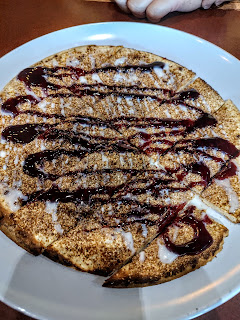 We splurged, and had two pizzas. these are 12 inch pizzas. Lunch pizza was a taco pizza, dessert was a cinnamon dusted crust, drizzled with raspberry and chocolate syrups. It was a fun day, now back home.


This whole area didn't exist back in the day of course. This eatery is like others that are a brewery/sports bar. The menu reminded us of Urban Pizza, in El Cajon. We sat down and ordered our drinks and food.


This stay was a shorter stay, next stop is Oklahoma.