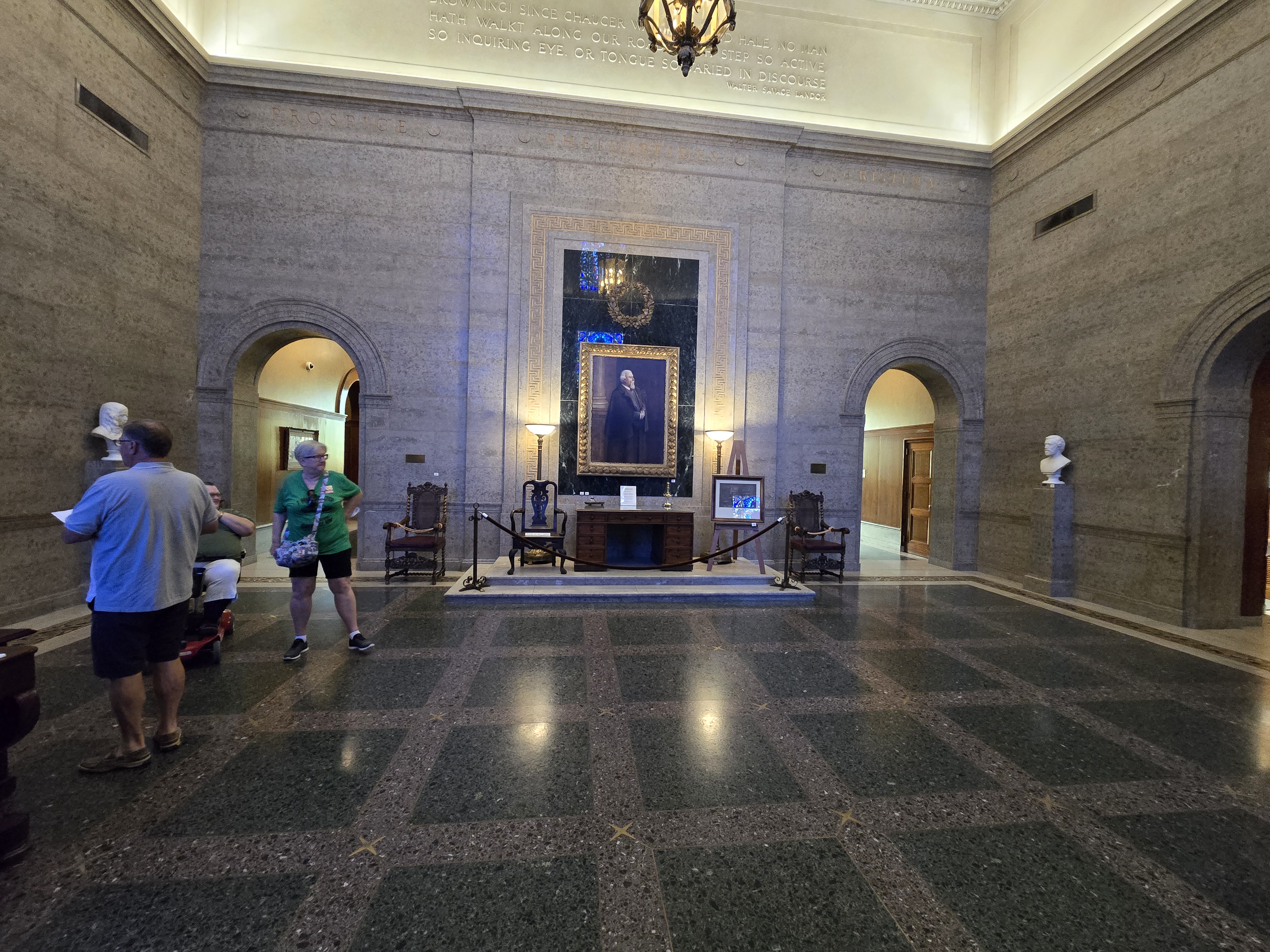
Besides the foyer on the first floor there was a library reading room, a theatre, and an event room. The library held many works from Browning as well as other era authors. The library also contained the card catalog for all the books and reference material within the library.As you may notice, there was a lot of stained glass in this library, and there was more to come.
PROFESSOR ARMSTRONG
Off to the event room, which also was home for more of the Browning family furnishings.
DESK USED BY THE BROWNINGS
Robert Browning wrote a poem for a 10 year-old boy called the Pied Piper of Hamelin, and these are pencil sketches the boy gave to Robert. There are actually four in the set, somehow the fourth one didn't make it to my camera.
Next stop was the theatre.
There were three large windows in this room, initially causing lighting (extreme glare) problems. The problem was solved by adding the yellow-gold tinting.
This room was used for speeches and music events. In the alcove visitors will find...the hands of the Browning's, and you can see how petite his wife's hand was.
POEMS FROM THE BROWNINGS
(located in the alcove)
As visitors walk through this library they will notice the ornate ceilings in each room.
THEATRE
EVENT ROOM
FOYER
RESEARCH LIBRARY
As we were on our way to the second floor we passed by alabaster plaques given to the library by a local couple.
They depict scenes from the Ghiberti panels on the baptistry doors in Florence, Italy. These are the same scenes used for the bronze doors of the library.
Up we went to the second floor. This floor had a rendering of the Browning parlor and a secure research room. But first...
A LOOK DOWN TO THE THEATRE FROM A BALCONY
First stop was the Browning Parlor. The furnishing were not exact, but represented how the parlor would have looked during their lives.
These stain glass windows represented different times in Elizabeth's life. In her youth she sustained an injury that would affect her for the rest of her life. As a child she was not able to participate in many of the family activities and was not expected to live a long life; the first window is of her and an angel, implying she would not live long. As the windows progress through her life they indicate the meeting of Robert, and eventual marriage.
Because of her disability she was not a strong woman. If you look real close at her writing desk, you can see that it was on wheels so that it could be moved around. Look closely at the chair, the spindles and legs are thin. By reducing the size of the spindles and legs, the weight was reduced, and Elizabeth could move the chair herself.
The next location on the second floor was that secure research room.
Only scholars get to use this room, and by appointment only. The way it works is a scholar requests one of the rare pieces of research material, then come to this room. If they need the material for more than a day, it will be locked away in a locker outside the room. NO, the material is locked away by a library custodian.
Final stop is the basement...
I told you earlier this library was filled with stain glass. These panes represent all the places the Browning's traveled to, or lived. Eventually they ended up back in England, where Elizabeth died.
After leaving the library we headed to the Texas Sports Hall of Fame. This was a long drive of about two miles from the Baylor campus.
The greatness of the place... air conditioning, it was starting to get muggy. This hall of fame covered all sports, pro and college.
When visitors walk pass the t-shirts, there are multiple rooms for discovery.
Across from the gift shop is the world of professional sports (bottom photo).
Strolling down, visitors enter the world of collegiate hall of famers. Some of the names here are also found in the professional section. Again, this area is set up by the different sports.
Each divider is a section unto itself for a specific college team.
For you baseball fans I have a snapshot of the glory days of Roger Clemens during his time at Texas.
A lot of the items in most of the exhibits were either donated by individuals or the school, with one exception, Baylor. Their entire exhibit was from personal donations because the school apparently doesn't believe in sharing the wealth.
I am going to presume that you need to be a Texan when it comes to knowing school records and championships won by schools. In the swimming arena, one of the schools has virtually won their division every year for the last three decades.
It was fun to learn the history of some of the mascots.
I chose the Texas teams I like to watch.
From the Texas Sports Hall of Fame we broke for lunch, which was provided by the hangout staff. This was a good breaking point for the three groups since we were all in the same area. After lunch one group headed to the Hall of Fame, another the to library, and the third group to the Texas Ranger Hall of Fame and Museum.
Lunch break over... off to the Texas Ranger Hall of Fame and Museum for us. The museum is walking distance from the Sports Hall of Fame.
Visit https://www.texasranger.org for more information about some of the Rangers recognized for their distinguished service. (very basic information) The website does have a section on the history of the Texas Rangers. I highly encourage you to browse this history.
Hourly they run a video story of the Rangers, which encompasses conception to present day Rangers.
Let's take a walk around the facility now. After passing through the foyer, we entered a hallway filled with exhibits of personal belongings from Rangers of the past, but that doesn't mean the 1800 necessarily.
If you have the ability to enlarge the photos, you may notice in one of them a glass slipper. That glass slipper is in the display talking about the female Rangers... that's right, it isn't all men in the game.
The Rangers have a headquarters and are broken down by regions. Stop and think how big Texas is, for those who have driven through this state, you know how big it is.
One section of the museum was dedicated to the Lone Ranger and Tonto. For those who grew up watching the Lone Ranger, you might remember the values that they instilled through their characters. It is thanks to Dolores "D" Taylor, M.D. She graciously allowed the museum to display her collection of Lone Ranger and Tonto memorabilia.
Some of us remember the Lone Ranger as the actor Clayton Moore, and Tonto as Jay Silverheels.
Clayton Moore didn't start out as the Lone Ranger. Before the Lone Ranger he was a circus acrobat and aerialist, model, stunt man, and a bit player in Hollywood movies. By late 1938 he was acting in "B" rated westerns, which earned him lead roles in several cliffhanger movies in the 40's and 50's. During WWII he served in the Army Air Force, First Motion Picture Unit, making training films.
1949 was his debut as the Lone Ranger on television. In 1952 he stepped back from playing the Lone Ranger, but he returned the next year to don the mask again. During his time as the Lone Ranger he and Jay appeared in 169 episodes. Clayton and Jay also did a full length movie. Until his death in 1999 he continued to portray the Lone Ranger and Ranger "ideals", promotional spots, and guest appearances.
I have only showed you a glimpse of the story of the Texas Rangers. I highly encourage you to look deeper into their history.
That ends day one of our week long journey.
On to the next tour adventures around Waco. Today we stopped at The Magnolia Silos, and the Dr Pepper Museum.
Some of you may be thinking, where have I heard of Magnolia Silos. If you ever spent time watching DYI shows, the names of Chip and Joanna Gaines my come to mind, they had a show renovating homes around Waco.
During one episode Chip fell in love with these silos. Apparently the city was going to tear them down. The Gaines did a bit more when they purchased the property, one was a store of course.
A little history regarding the silos is in order. The 120 foot high silos were built in 1950, serving as storage for the Brazos Valley Cotton Oil Company. The silos only operated for about three years. Why such a short time... an F5 tornado in 1953 ripped through Waco killing 114 people and destroying over 1,000 homes. The silos escaped any significant damage, but remained unused.
The entire grounds were part of the Brazos Valley Cotton Oil Company, established in 1910. Though they survived the depression and the 1953 tornado, other hardships caused them to close their doors in the 1990s. Chip and Joanna bought the grounds in 2014 with a vision for people to enjoy.
The mill became the store, some of the grounds became an open area, a short stroll and visitors can find more little shops filled with vendors. If visitors are hungry, there were about 10 food trucks to tease one's pallet; we tried the Korean BBQ truck.
For nature lovers there was a flower garden and a herbarium (Garden Shop).
The building was originally storage and retail space for the original Magnolia Market at a different location, but was moved here with a new purpose. There is a garden team that maintains these beds year round. Beyond their beauty, there is a true purpose, the garden supplies food for Magnolia Table, The Salvation Army, and World Hunger Relief Farm in Waco.
From here we walked over to the Dr Pepper Museum.
https://drpeppermuseum.com While we were waiting for our tour several folks commented on a picture on the wall of a cup of hot Dr Pepper with a slice of lemon, having never heard of the idea. I told them that I use to drink it all the time during the winter when I lived in Kansas.
Understand that Dr Pepper is a "native Texan". The history of Dr Pepper started around 1885 with a young man named Charles Alderson. Most of his time was spent mixing drugs for customers, but on his off time he worked on creating carbonated drinks for his customers. He continued improving his formula, testing it on his boss. Once the formula was set, he began serving it to the customer.
Charles was more interested in being a pharmacist, and suggested that his boss Mr. Morrison and another gentleman by the name of Robert Lazenby, who was a beverage chemist, further develop the recipe. The two formed a company called Artisan Manufacturing & Bottling Company, later to known as the Dr Pepper Company.
If you are a big fan of Dr Pepper you know that on their bottles were the numbers 10, 2, and 4. Research in the 1920s and 30s found that the average person needed a sugar pick-me-up around 10:30, 2:30, and 4:30 during their day. The company held a contest and arrived at the advertising gimmick of 10-2-4 for their product.
You may be wondering why my punctuation on Dr is missing the period... in the 1950s they decided to drop the period.
Slogans were and are a big part of the business. In 1950 the slogan was "the friendly pepper-upper". Dr Pepper felt that they were a misunderstood soft drink, and in 1970 came up with the slogan "the most original soft drink ever in the whole wide world". In 1977 they updated the slogan to something a bit simpler, "Be a Pepper". Today we now see Dr Pepper as " There's just more to it".
Our tour is about to begin, so let's head inside. The museum is two stories in one building and the first floor in the other.
Before we enter the "old corner drugstore" they gave a little history lesson on tornados, probably because it did do quite a bit of damage to the original plant.
This is where the story began. Passing through the drugstore we entered the museum/old plant.
There are two items necessary for creating Dr Pepper, syrup, and water.
The well in the photo was the original well used to create Dr Pepper, along with the syrup. The well was dug during the time of the building construction, and used from 1906 to 1920. There is still water in the well.
Their process for bottling the syrup and getting it out to the customer involved multiple employees. One would fill a jug, the next guy would add the label, third guy would wrap the jug in wax paper, a fourth guy sealed the jug. Then there was two guys loading the jugs into crates and closing them. Think about being the guys loading the crates, handling each jug at 14 pounds a piece, for 8 to 10 hours a day... you got muscle?
They did a nice job in this part which spoke to the bottling process. Where you see foot steps was a station explaining a part of the process.
TWO STYLES OF BOTTLE CAPPING MACHINES
LIQUID RED DIAMOND CARBONATOR
ROCKING CARBONATOR
The rocking carbonator introduced the CO2 into the filtered water by rocking the tank, agitating the water. The Diamond carbonator added the CO2 into the filtered water but the a process differed from the rocking carbonator, it used a mechanical paddle within the machine.
From here we moved upstairs to continue our tour. The guide would explain a bit about the exhibits, then we were off to explore on our own.
MINI SIX-PACK CIRCA 1969
WITH TWIST TOP
Some may not realize that Dr Pepper made other sodas as well, and sold their products around the world.
PRODUCTS SOLD IN SOUTH AMERICA
EASTERN ASIA
KOSHER PRODUCTS FOR ISRAEL
Off to the other building now. The second building contained some of the early vehicles to deliver Dr Pepper, as well as a bottling assembly line:
At the end of the tour we received a bottle of Dr Pepper. Visitors could stop at the soda fountain and get a float if they chose to.
Carol and I took a walk over to the gift shop for our souvenirs. I was a bit disappointed that I couldn't get my coconut Dr Pepper. Come to find out it was only a seasonal item last year.
Back home to get ready for a gathering of the masses.
Get togethers were Texas themed, except for the first one which was a meet and greet. The park gave us the run of the clubhouse and pool area. The next gathering was a Dr. Pepper ice cream float theme. Some of us may have taken it a bit too far... ya think
I am one of those people that does not belief in waste. The ice cream container was close to empty, but still had ice cream in it, so why not add a bit of Dr Pepper. Just consider it a large cup.
One day we went out as a group to a Mexican restaurant.
As you may be able to see, there were a lot of us. The bald head at the bottom right is mine, Carol and I sat at the end of one table. Just so you understand, all those folk in this room were our group. The day we went was $2.00 margarita day. The food was very good, and considering the size of the party, service was good too.
Our next outing was to Homestead Heritage. (https://www.homesteadheritage.com)
They are a church based community that believes in the enrichment of visitors through the display of artisan skills. Though we didn't eat in the restaurant, we were told they have excellent food. Many of the people live on this acreage called Homestead Heritage.
The buildings are all reclaimed buildings set to be destroyed, and this community purchased them and repurposed them.
First stop on the tour was the woodworking shop.
THIS WALNUT IS A TABLE IN PROGRESS
MOST OF THEIR WORK IS DONE BY HAND
In the bottom photo, upper left, is a church pew they were working on. They had been commissioned to redesign the ends...
I have forgotten the reason for the change, but I do remember they came from a church that was no longer attended.
You may notice that the gentleman is sniffing something... that "something" is a ribbon of sassafras from the block of wood being planed.
The next demonstration was the creation of a dove-tail joint.
Commonly these joints are seen on drawers of high quality furniture.
Here is some of their other works.
They also offer classes on different subjects.
Our next stop was to the blacksmith shop where they explained that most of the metal work at the homestead was done by the blacksmiths on site. The blacksmith demonstration was a leaf and stem keychain.
From here we walked to the pottery shop for a demonstration on making pottery...
then over to the gristmill.
This was an operating gristmill making a variety of flours.
What you are looking at is the grist mill which dates to circa 1760. Back around 1850 there over 23,000 gristmills in the United States amongst the small villages that dotted the countryside. Today there only about 200 operational in the U.S., and this is one of two in Texas.
Like most machinery back in the day they were driven by water and a series of belts.
Leaving the gristmill we strolled over to the fiber craft building.
Here they had demonstrations on making various fiber threads. One of the rooms was set up with a variety of looms that had different functions. Like the other areas at the homestead, they have classes as well.
For our last stop it required us to jump in the truck and drive about a 1/2 mile.
Yes, those are their cheese wheels.
Before the last stop was an important stop that should be done before leaving the Homestead Heritage...
Carol did walk away with some chocolate, I just had a hot chocolate.
We headed home to another social event, and preparations the next tour day.
Our group's first stop was to a classic car museum in Clifton, TX.
This museum is really a collection of cars from local residents, and the owner of the museum. Some of the cars brought back memories as far back as my childhood.
This 1950 Plymouth was an example of a memory my early driving days. My great uncle worked for General Mills as a salesman, and he drove a 1950 Chrysler Windsor. His car was green with green interior. What is hard to see in the photos is that the interiors were similar, horse hair carpet and moleskin upholstery, semi-automatic transmission, and a radio. You might be wondering what a semi-automatic transmission was... I had to engage the clutch to shift to first, let off the gas to shift to second, engage the clutch to shift to third, and let off the gas to shift to fourth. Why do I know so much about this car, it was given to me when my great uncle died, and I drove it half of my high school days... in the 70s.
1957 MERCURY
AIR FLOW VENTS TO PASSENGER CABIN
AUTOMATIC LUBRICATION SYSTEM
This Merc had many new innovations. With a button from the dash, the driver/passenger could lubricate the car. Instead of air vents coming from the fender area of cars, this Merc's air came from the top of the windshield area.
One of the cars on display was a 1965 gold Buick Rivera. Yah, so... that was one of the first car models I ever built. I was at my grandmother's house in Kansas for the summer. When I completed it and went home, by train, I carried in a separate suitcase.
One of the cars on display was owned by the gentleman that gave us the run of the museum, and he works on all the cars to keep them running. You see, they use some of the convertibles for special events like parades.
It was time to move on to our next tour stop, the Bosque (pronounced Bos-kee) Museum.
https://www.bosquemuseum.org
This was the original home of the Olson family, Norwegian immigrants who settled in Texas in 1858. This log cabin was built by Joseph Olson, the father, in 1866.
What is the importance of this log cabin? it was Jacob Olson's childhood home. Big deal you say. Jacob was the gentleman that donated all the Norwegian artifacts to begin with. The website will give you a little more insight.
The cabin stayed in the Olson family until the 1970s, after that it moved to various locations, finally resting in its current location in 1985.
Let's jump back a bit and talk about the Olson family. The Olson family consisted of both parents and four children, one daughter, three sons. The interesting part of the journey is their 8-year daughter getting Texas fever, which grew on the parents after awhile.
Now the hard part of their journey began. It was a seven week boat ride which ended at Quebec, Canada. Leaving Canada, they arrived at Norman Hill, Bosque County. It wasn't an easy trip either, their journey was by oxcart, which carried two other families. Image yourself in a Mini Cooper with your family of six, and two other families that may have been about the same size... what fun!
Once they arrived they stayed at the home of another immigrant, under particular conditions. This immigrant was a bachelor, and those conditions for renting a room... Jacob's mom would cook meals, and do his laundry, and she did this for seven years.
Joseph, the father was not a bum, he got a 160-acre farm and began building that huge cabin (14ft x 15ft). The cabin was finished in 1867, and they moved in. This is where Joseph and Anna lived until they died. Jacob, their second son inherited the cabin and farm which remained in the family until 1970s.
The new owner of the farm could no longer preserve the cabin so he donated the cabin to a charitable society and it remained at that society until 1982, when a couple were interested in the history of the cabin and offered to move it back to Clifton. In 1985 the museum accepted the cabin. Through fundraising efforts the cabin was restored using the same materials that Joseph did when it was first built, and the furnishings were donated by local families.
Let's walk inside. Nothing you see below is in any order, just pictures.
OVERVIEW OF FOSSIL ROOM
TOOLS OF THE ERA
GUN COLLECTION
HAIR NECKLACES
HAIR ART
The art is from a local artist.
Our last stop on this hangout was the Mammoth Monument.
https://www.nps.gov/waco/index.htm
The discovery of these particular mammoths occurred by total accident because of two boys trespassing on someone's property looking for arrowheads.
The boys were smart enough to take the bone they found to Baylor University's Strecker Museum for evaluation. The museum staff took swift action and between 1978 and 1990 uncovered 16 Columbian mammoths in the ravine where the original bone was found. The fossils were of young and old mammoths, indicating that they had found a "nursery" herd (female and babies) which apparently all died together thanks to a natural unknown event. To enter the building containing the next six mammoths, visitors need to pass over the ravine.
Because the current excavation of the six mammoths, the park service does not allow food and drink in the building, we had to leave our water bottles outside at the door.
This painting on the wall is a representation of the size of a Columbian mammoth. These creature could reach a height of 14 feet, and weigh up to 20,000 pounds; much larger than the Wooly mammoth.
Besides the nursery herd they have found a few other fossils like:
WESTERN CAMEL
This camel appears to be at the same time level as the nursery herd, indicating that these two species were comfortable with one another.
This is the remains of a male Columbian mammoth. He appears to have been caught in a different natural event at a later time. They know that this male did not travel with the nursery herd because the female would drive the male aways when they got older. Its believed that once the male was driven from the nursery herd they roamed the countryside by themselves.
As I said earlier, the site is still an active site, the college students were on break during our visit, and probably be back in the fall.
I do encourage you to visit the websites and learn a bit more than what I have shared.
From the Waco Hangout we traveled to Colorado to visit our youngest son. You may be thinking that's cool, they actually stay in contact with their kids, it's true, but there was an alternate reason.
We raised our sons to be independent, and sometimes there is a price to pay for that accomplishment. In our case it came in the form of a phone call while we were at Escapade. I'll keep the phone call short:
Mom/dad - "good to hear from you."
Tyler - "I got married a few days ago."
Mom/dad - "how long have you known her?"
Tyler - "two years, we met online." "She is Italian."
Mom/dad - "when can we meet her."
Tyler - " she is in Italy", and by the way, I am moving to Italy."
Mom/dad - "we're happy for you."
Their plans were for him to leave sometime in May, but that didn't happen. The joys of being a parent. After seeing him we headed home to New Mexico to plan our next journey.
See you all later.