Thursday, June 17, 2021

Back to Deadwood

Now that the rain took a break, we headed back up to Deadwood, with our goal to visit Mt. Moriah cemetery, and the Days of '76 Museum.

Days of '76 Museum (https://www.deadwoodhistory.com)  is a trip back in time, discovering how the Dakota Territory, and Deadwood were settled. 

The beginning point of the exhibits is a short tale of the "Days of '76 Parade". The parade and celebration help visitors visualize the making of Deadwood. The parade itself is organized in a timeline fashion, beginning with the American flag. The next segment usually consists of the color guard, rodeo committee, and bands. 

The starting point for the timeline begin with the Indians. At the peak of this parade there were as many as 150 Indians participating in the celebration, that number has dwindled since.

Following the Indians are the pioneers. In this group there are the trappers, explorers, scouts, settlers, and pioneers. Exploration companies include Ezra Kind party, the Gordon party, Frank Bryant party. Marching along with this segment is Custer and his troops. A white woman named Annie Tallent can be seen walking in this group. What is so important that Annie is mentioned? she is believed to have been the first white woman to enter the Black Hills.

Now we get to an era that some of us might just remember...whether lived it, or read about it. This group marching down the street represent the gold rush days. You can see people like Poker Alice, Deadwood Dick, Jack McCall, Calamity Jane, Wild Bill Hickok, Preacher Smith, and Yellow Doll. Because there was an active Chinese community, you will find representatives from Chinatown.

Behind this group you will see examples of growth and industry. This segment contains the vehicles of progress, from stagecoaches to working wagons (which you see later). There would also be representatives from some of the industries that made Deadwood.

The following segments have participants from cowboys to scouting organizations.

In we go to the workings of the museum.

A big part of the celebrations is the rodeo that occurs at the grounds next to the museum. There were many exhibits and artifacts that spoke of the bronc busters, bull riders, and barrel racers, but I gravitated to the section that best described what I would have like to do... a rodeo clown.
Bennie Bender was a local boy from South Dakota. He was a rodeo clown, bullfighter, and contestant, performing many times between 1940 and 1960. Rodeo clowns are a tough breed, like a bull rider with a painted face. Can you see yourself in a barrel with a bull running at full speed, hunting you down?
These barrels are not the luxury they look like from the outside, there is not padding inside. What about trying to outrun that mean bull riding your trusty stead.
All I would say... your stead better be faster than the bull.

I'm thinking some of you wouldn't do it, just because of the wardrobe.

Remember I mentioned that the museum was a timeline of events that occurred in the territory? One event that was partially documented was Wounded Knee. 

The first Wounded Knee incident happed back in 1890. The U.S. government was concerned with the Ghost Dance spiritual movement, which taught that they were being confined to reservations because they angered the gods. The Sioux believed that if they practiced the Ghost Dance, and rejected white-mans ways, the gods would bring about a new world, and destroy all non-believers. In December 15, 1890 the reservation police tried to arrest Sitting Bull, mistakenly believing he was a Ghost Dancer. In their attempt to arrest him things went awry, and they inadvertently killed him. This increased tensions at Pineridge. 

December 29th the 7th Calvary surrounded the Ghost Dancers, and demanded that all weapons be given over to the Army. A fight broke out between and American Indian and a soldier. A shot was fired, but it was unclear which side fired the shot... end result was 150 American Indians killed that day at Wounded Knee. Half of the Indians slaughtered were women and children; the Army only lost 25 men.

The massacre was avoidable, the Indians were surrounded by heavily armed soldiers, and most likely would not have attacked. It is believed that the 7th Calvary may have had revenge on their minds because of the massacre at Little Bighorn in 1876. This massacre at Wounded Knee ended the Ghost Dance spiritual movement.

Now we jump forward in history to the 1960s. A new Indian movement arose, American Indian Movement (A.I.M.), in protest to the harassment of Native American Indians in Minneapolis. A.I.M. gained notoriety with their protests, however, the mainstream Indian leaders did not approve of their methods.

During 1972, A.I.M. attempted to reduce the divide with traditional tribal elders on reservations. The greatest success was at Pineridge Reservation, in southwestern South Dakota, when a group of whites murdered a Sioux named Yellow Thunder. Even though the murderers only got 6-years, it was considered a victory for the movement, the movement gained respect on the reservations.

Now in 1973 the trouble begins. The prestige and influence the movement was receiving worried a conservative Sioux tribal chairman, Dick Wilson. This guy ran back to the reservation, and under protection of the federal marshals and Bureau of Indian Affairs police. A.I.M. was smart enough to not assault the reservation headquarters at Pineridge, so they chose the symbolic Wounded Knee. With backing of the federal government, Wilson attacked Wounded Knee. The siege lasted 71 days before the movement surrendered. Casualties were two died Indians, and a permanently paralyzed federal marshal.
This breastplate is an example of the violence that occurred. The breastplate is made from government 30-06, and .38 caliber shells from F.B.I. agents, and federal officers.
There is a little more information at:
https://www.history.com/this-day-in-history/aim-occupation-of-wounded-knee-begins.

After we finished the first floor we headed downstairs to the working world.
The starting point for the basement exhibits.

The lower floor is setup by timeline, starting at 1875. You need to remember that there was a agreement made between the Indians and the government, allowing the Indians to keep the Black Hills as their sacred hunting grounds. So when 1876 arrived, along with gold seekers, there were issues. The government had agreed to keep the miners out, but it wasn't so easy. 
The miners knew they weren't welcome, evidenced by the Army soldiers and Sioux warriors reeking havoc. It was difficult for freight trains (called "bull trains) to get into Deadwood, thanks to the above mentioned. Fred Evans' first attempt was an example of how tough it was. The Army stopped him, took his teams of critters, and burned his wagons. In 1880, with persistence, Fred got through, thanks to another agreement that took the land away from the Sioux.

This "Mountain Wagon", usually a sign of a family comfortably well off. This guy was loaded, brakes, heavy duty springs, back seat was removable for carrying cargo. This was the SUV of the day.

Recognize who manufactured this carriage? This carriage was not built for the Black Hills, it was a sign that Deadwood was growing into a civilized town. This carriage was the high end for this manufacturer... that's Studebaker by the way... the only wagon manufacturer to successfully migrate to automobiles.

Some other carriages of the time:


Carol has made her choice.
Milk or Beer? What's your choice?
This wagon has a 5th wheel that allowed it to make tight turns, or back into tight spaces.

How many of us have been behind those big trucks hauling dirt, gravel, or rock? they are are not new to to 20th century, their cousins were being used in the Black Hills back in the 1890s.
The bottom photo is looking through the bottom of the dump wagon. These wagons were used for building roads, and excavating, because they were able to haul heavy loads.
This is just another example of today's technology rooted in the yester years.

After the disastrous fire that destroyed a major portion of the commercial sector, Deadwood built a new firehouse/city hall brick building in 1889. With a new firehouse, came new fire equipment, in the form of a horse drawn hook and ladder truck.

It didn't take long for the "gold boom" to grow Deadwood from a mining camp to an industrial town. Within the first year of gold being discovered, stamping mills were established. For those that do not know about stamping mills... rocks containing gold ore were brought to a mill, dumped into a bin that fed a stamping mechanism that crushed the rocks to a product that could be further processed. As mining grew, mining operations grew as well, requiring larger equipment. 
Above is an example of equipment that needed to be brought in over the mountains. In the case of the above photo, we are talking a 13,000 lb. boiler. The Homestake Mine used similar wagons to haul equipment between Deadwood and Lead (pronounced Leed).

After all the hard work was over, for good, you might get to ride in your final wagon...
to Mt. Moriah Cemetery.

Speaking of Mt. Moriah Cemetery... our next stop. 
https://www.cityofdeadwood.com/community/page/mount-moriah-cemetery

The first Deadwood cemetery was begun in 1875, and wasn't originally called Mt. Moriah, in fact it really didn't have a name. Newspapers weren't established until mid-1876, occasionally reporting deaths, and when they did, it was evident that the cemetery was nameless. Up to 1878 the cemetery had been called "the Deadwood Cemetery", "cemetery on the hill", "City Cemetery", and "old graveyard in South Deadwood". After the creation of Mt. Moriah in 1878, the first cemetery was known as the "Old Deadwood Cemetery". Several buried residents were exhumed and moved from the first cemetery to Mt. Moriah, James Butler Hickok in 1879, and Henry Weston Smith in 1883.

Mt. Moriah Cemetery became home for more than 3,600 residents during it's active time, 1878 to 1949. In 1967 the city of Deadwood hired a landscape architect to develop a master plan for the cemetery... time was not good to the cemetery. The recommendations were for eliminating vehicular traffic, developing pedestrian transportation, suitable interpretation, and cemetery improvements.  Unfortunately lack of funding delayed any renovations for the next ten years. In the mid-1980s, the city of Deadwood began charging an entrance fee. 
Another decade would pass before the cemetery under went a $4.8 million dollar renovation funded by the Deadwood Historic Preservation Commission.
This is the original section of the cemetery, before they expanded uphill.
Mt. Moriah was created during the Victorian era, and there is a lot of symbology that can be seen on many grave markers. The cemetery is a multi-cultural resting place for Jews, Christians, Chinese, and the destitute.
Human body parts symbolized different things depending on how they were posed or positioned. Hands shaking usually meant a heavenly welcome, or an earthly farewell. If one of the hands was a feminine, and the other masculine, it usually indicated matrimony. A hand with a pointing finger had meaning as well. Two interpretations can be found. The first one is a hand with the finger pointing up, meaning the deceased had move on to heaven. The second option was a hand with the finger pointing down, generally referencing the hand of God emerging from the clouds.

There were symbols related to religion, fraternal organizations, fauna, and flora. Remember, this was a multi-cultural cemetery. There is the Star of David, gates of heaven, angels, and crosses. Fraternal organizations included the Freemasons, Elks, Modern Woodman of America, and the Independent Order of the Oddfellows. Fauna representation was usually either a lamb, or doves. A lamb would often be found on a child's gravesite. The lamb signified innocence. Gravestones with doves holding an olive branch represented purity and peace.

I never really thought about the importance of symbology in death.

With the first recorded Jewish community in South Dakota. The Hebrew Cemetery Association purchased a section of the cemetery for the Jewish community. Many of the influential Jewish pioneers are resting there. An example is Harris Franklin, whose Deadwood interests included banking, ranching, and mining. His son was a two time mayor of Deadwood. It was said that during his Eulogy "he was never known to foreclose a mortgage.

If you are following this blog you know some of the other famous people resting here at Mt. Moriah.

Walking the cemetery, there is a lot to see, because it looks over the town of Deadwood.
The Chinese community was a big part of Deadwood, and there are some of the community buried throughout the cemetery, although the biggest group were interned in section six. In 1908 the Deadwood Chinese community received permission to erect a burner and alter.
The Chinese community brought food offerings, and incinerated paper offerings. By 1920 there was a decline in the Chinese community, and the burner alter fell into disrepair. It wasn't until 2003 that the original site was mapped and tested.  A new burner alter was in the future, and the bricks would come from the demolition of the Chinese Wing Tsue building. Jumping forward to July 2013, the burner alter was officially dedicated, commemorating the 50 year history of the Chinese community in Deadwood. 

There are several sections dedicated to the mass deaths of children that died from smallpox, scarlet fever, and diphtheria outbreaks.

For the small entrance fee, it was worth the visit. Our day was coming to an end, so we headed home.

Sunday, June 6, 2021

Knee Deep in South Dakota Characters

 WE'RE IN A RAIN DELAY FOLKS.

While we are in a rain delay, let's talk about some of the characters that made up Deadwood in the day.

How many out there have heard of Seth Bullock? Seth was born in Canada, and following Horace Greeley's advice, headed west. He first settled in Helena Montana, made a name for himself, and was elected to the Territory State Senate for the State of Montana. While in Montana he went on an exploratory trip to Yellowstone. Discovering its magnificents, he proposed a resolution for protecting the land, and in March of 1872 it was declared a national park.

By 1874 Seth is a married man. He married a young lady, Martha Eccles, in Salt Lake City. 1876 rolled around and Seth and his business partner had the urge to relocate their hardware business to the booming gold town of Deadwood, in the Dakota Territory. Knowing Deadwood was a lawless town, Seth sent his wife and child to her family's home in Michigan.

Seth and his partner loaded up their wagons with Dutch ovens, fry pans, rope, chamber pots, all the things a mining camp needed, and when they got there, they unloaded their supplies by rope down the sandstone cliffs. They arrived in Deadwood August 1, 1876, the day before James Hickok was murdered.

With the killing of Hickok, there was clamoring about the lawlessness in the town. Somehow Seth Bullock was appointed Sheriff. His first act as Sheriff, according to his grandson, was to confront Wyatt Earp about the Sheriff position. Seth informed Wyatt that the position was filled, and requested that Wyatt leave town, Wyatt obliged.

Seth's strength of character, and his creativity helped to tame the untamed, and made it into a stable permanent community. His creativity was evident during a standoff between miners and the owners of the Keets Mine. The miners seized the mine in a dispute over wages. Sheriff Bullock was concerned that it could turn into a gun battle between the two sides. With some thinking Sheriff Bullock came up with a solution. He went to Deadwood's Chinatown and purchased sulphur. He lit a load of sulphur and lowered it down into the mine. The results were immediate, as the miners came streaming out, giving themselves up without a shot fired.

With Deadwood grasping law and order, Seth sent for his wife and child. Martha became a pillar of the city, bringing stability and culture to the city. The Bullocks were the founders of the Round Table Club, which is the oldest cultural club in the region.

In 1884 while on the range of his ranch Seth came across three riders that looked pretty travel weary. Being a Deputy U.S. Marshal, his curiosity was peaked, he felt a need to question the three riders. Seth learned that one of the riders was Theodore Roosevelt, a Deputy Sheriff from Medora. Bullock and Roosevelt being cut from the same cloth became good friends. In fact the friendship was so strong that Roosevelt sent his sons to visit Bullock on the ranch during summers.

When the Spanish American War broke out, Bullock volunteered with Teddy's Rough Riders, and named Captain of Troop A in Grigsby's cowboy regiment. After the war, Bullock, now called "Captain" organized a group of cowboys from Wyoming, Montana, South Dakota, and Nebraska to attend Roosevelt's presidential inauguration in 1905. The group rode down the parade route, roping onlookers occasionally. They were greeted by Teddy at the White House.

Seth Bullock so admired Theodore Roosevelt, that he had a memorial dedicated to him. Teddy's death in 1919 was a blow to Seth. He enlisted the help of the Society of Black Hills Pioneers. The monument was erected on Sheep Mountain, later renamed Mt. Roosevelt. The monument was erected in 1919, Seth Bullock died a few months later in 1920. Seth Bullock is buried on a hill in Mt. Moriah Cemetery, looking across the gulch to the monument of his good friend.

This was the road to get to Seth's resting place. The hike was about a 1/4 mile uphill... one way anyway.
The hike down was a lot easier.

The Theodore Roosevelt Memorial, dedicated on July 4, 1919. The monument has an internal staircase that leads to the viewing deck. It was repaired in 2010 to provide a safe experience for visitors. It stands 30 feet tall, with a slim waistline of 12 feet. Today the monument stands as a silent reminder of a friendship between two prominent men that shaped the nation, and the south Dakota Territory.


This gentleman was Johnny Perrett, more commonly known as "Potato Creek Johnny". He was a prospector in the Black Hills, mining predominately around Iron Creek and Potato Creek. Johnny originally haled from Wales, arriving in the area in 1883. He is the miner that brought the largest gold nugget from these hills, and a replica is displayed in the Adams Museum. Johnny was a favorite among the people he met, either at his sites, or on The streets of Deadwood. Spending most of his life mining for gold, Johnny died in 1943, and is buried near "Wild Bill" Hickok and "Calamity Jane" in Mt. Moriah cemetery.


Henry Weston Smith, "Preacher Smith" did not arrive in Deadwood until 1876. Originally from Connecticut, ordained a minister at age 23. In 1861 he enlisted in the Army as the country was choosing its sides for the Civil War. After he left the Army he did not go immediately back to preaching, instead he studied medicine and began his practice in 1876. 

Henry moved his family to Kentucky. Hearing about the gold strikes in the Dakota Territory, he left Kentucky, and arrived in Deadwood May of 1876. Being a new community it was a tough time for the miners, but in the summer of '76 the Indians calmed down some. 

Henry got back his passion for preaching, and figured he would take the Divine Word to nearby mining communities. He left his cabin on 20 August 1876, pinning a note to the door that read "Gone to Crook City and if God willing, will be back at 2 pm". Unfortunately that afternoon he was ambushed by Indians. When his body was found, it was neither mutilated nor robbed. His hands were folded across his chest, his bible tucked underneath them. In his pocket was the sermon he planned to deliver to the miners at Crooked Creek. That sermon is read annually during memorial services for him here in the Black Hills churches.


Martha Cannary, better known to you as "Calamity Jane". Martha started out in Missouri as the oldest of six children. In 1865 her parents took the family to the Montana Territory, in Virginia City. The six siblings became orphans after their parents died in 1866 and '67. 

Martha move to the Wyoming Territory; this is where the real story began. She was a dance-hall girl, waitress, laundress, and a prostitute at railroad camps and millitary posts along the Union Pacific Railroad. By dressing like a man she able to find other work. Dressing like a man eventually defined her future persona.

It is not really clear how Martha got the name "Calamity Jane". One account says that a Captain James Egan, while at Goose Creek in Wyoming stated "I name you Calamity Jane, heroine of the Plains!". Her notoriety came largely from dime store novels, articles, even her own autobiography. All the stories had her being a crack shot, bullwhacker, expert scout, teamster, and western heroine. The truth of the matter was that she was an alcoholic, which may have prompted all the fanciful yarns about her. While in Deadwood she was known as a party girl, but few knew the other side of Martha. During the smallpox epidemic, Martha tended to the sick with total disregard for her own life. Many of the stricken miners called her "an angel".

By 1891 Martha is living in Texas, and marries a gentleman named Clinton Burke. Unfortunately she is getting sicker, and  decides to board a train for Terry South Dakota in 1903. When she arrived she rented a room at the Calloway Hotel, where she died August 1, 1903 from a combination of inflammation of the bowels and pneumonia, she was only 47 years old. Because she had a crush on James Hickok, Martha's last request was to be buried next to "Wild Bill". She is buried as Martha Burke, a.k.a. "Calamity Jane", next to "Wild Bill".


James Butler Hickok... that's right... "Wild Bill Hickok". James was born in 1837 in Illinois, and raised to be honest and fair.  His parents apparently believed all men were truly created equal, because his childhood family farm was a stopping point in the Underground Railroad.

Apparently farming wasn't his desired lifelong career, because at age 17 he left  home and worked as a canal boat captain in Utica Illinois, before heading to Kansas in 1856. The town he moved to was embroiled in a dispute over slavery. James joined the antislavery Free State Army of Jayhawkers. Skilled with a gun from youth, he was assigned as the bodyguard for General James H. Lanes. 

Destiny was about to create a lasting friendship. While serving in the Army, he stopped a man from beating an 11-year old boy... that boy grew up to be William Frederick Cody, better known as "Buffalo Bill Cody". 

A few years later, 1858, he was appointed as a Constable in Monticello, Kansas. Later that year he began working for the creators of the Pony Express as a teamster, driving freight wagons. James was not a rider, he was too tall, and weighed too much. His legend would grow during his time in Kansas. There was a story about him running freight, and a bear was blocking the road. James used his shooting skills and shot the bear... one problem... it only angered the bear. Supposedly he slit the bears throat, only after nearly being crushed by the bear. The truth of the matter was that James was in bed for several months after the attack. 

After healing James headed for southern Nebraska in the 1860s, ending up at the Rock Creek Pony Express station. His time there was not without troubles, the biggest was the "McCanles Massacre. James was not always known as "Wild Bill", early on he was known as "Duck Bill". He was called that because of his sweeping nose, and protruding upper lip. Anyway, there are several stories regarding the the shoot out between the McCanles' and Pony Express employees, which occurred before the start of the Civil War.

James fought on the side of the Union Army as a spy, scout, and sharpshooter. It is presumed during this time that James gave himself the name "Wild Bill". In 1866 "Wild Bill" was a guide for Gen. William T. Sherman while he toured the west. In In 1867-68 he was a scout for Gen. Winfield Hancock, and Lt. Col. George Custer.

"Wild Bill" was a favourite of Custer and his wife Libby, who described him "as a delight to look upon". You see Hickok was described as "six feet tall, lithe, active, sinewy, daring rider, a dead shot with a pistol or rifle, long locks, fine features and mustache, buckskin leggings, red shirt, broad-brim hat, twin pistols in belt, rifle in hand". How's that for a visual?

In 1869 "Wild Bill" was the Sheriff of Hays City, Kansas. In 1871 he assumed the duties as Marshal in the rough cow town of Abilene, Kansas. He was responsible for killing several men in shootouts as both sheriff and marshal. The accidental shooting of his deputy marshal in Abilene was cause for dismissal.

In 1873 "Wild Bill" tried his hand acting in Wild West shows, his own which failed, and the Buffalo Bill Cody's Wild West Show. He was unhappy doing the shows and bowed out in 1874, and headed back west to Cheyenne Wyoming. While in Cheyenne in 1876 he met and married a young lady named Agnes Lake Thatcher, and after their honeymoon in Cincinnati, he left for the gold fields of the Black Hills in Dakota Territory.

He traveled to Deadwood via a wagon train, which by chance had a young lady by the name of Martha Cannary traveling to Deadwood as well. The town was definitely unruly, eventually "Wild Bill" became the law in July of 1876. I am willing to guess that he took the peace officer position with some reservation... his eyes were failing due to glaucoma. Unfortunately 1876 was not a good year for "Wild Bill". His hope was to earn enough money to bring his bride to Deadwood, but he was murdered while playing cards, August 2, 1876. He is buried in Mt. Moriah cemetery... several times. He is buried with all the other Deadwood celebrities.
As you can see, he and "Calamity Jane" are buried next to each other.


This is Jack McCall, the infamous murderer of "Wild Bill" Hickok. On the day of 2 August 1876 Jack walked up to "Wild Bill", and shot him point blank in the back of his head. His reasoning for shooting "Wild Bill", was to avenge the death of his brother, whom "Wild Bill" killed. On August 3rd a trial was held, and he was found innocent. 

Jack's downfall was his big mouth. While in the Wyoming Territory he bragged about killing "Wild Bill" so much, that a U.S. marshal arrested him. Here is why one should learn to keep their mouth shut after getting away with murder. It was determined that the trial held in Deadwood was illegal, because Deadwood was not in a legal territory. Jack was hauled over to Yankton, the capital of the Dakota Territory. His visit to Yankton was short lived, he was retried, convicted, and hanged in the spring of 1877. Jack was buried in an unmarked grave, probably in Yankton.

There are many other characters that made up Deadwood, with a little research on your own, try to find out who they were, someone may be a long lost ancestor.

Saturday, May 29, 2021

Knee Deep in South Dakota

 Today we made a run before the rain drops to Deadwood for a day outing.

Last year we only drove through the town, there was construction everywhere. It was a little different this year. One of the big hotels downtown is growing bigger, closing one side of the the already small downtown street. To give you an idea how narrow the street is, imagine a one lane road with a traffic signal controlling the two-way traffic... now you're there with us. The signal seemed to take an extremely long time to change. We drove the street to the end, where we turned around due to ... road work.

We drove back to the Visitor's Center to find parking, free of course. It was a good starting point for the day. The Deadwood trolley also leaves from the center. The cost for the trolley is $1.00, unless the rider picks up a Trolley Passport. The passport has tear out pages that can be used when riding the trolley. The tear out pages are some of the attractions the trolley stops at. 

First we rode the trolley long enough to find food, then we climbed back on for a round trip ride, only to get off at an unscheduled stop. 

Information point: https://www.deadwoodhistory.com/about-us/properties.

This is the Adams House. This home was actually owned by two different families, the Adams' family being the last. The home was built in 1892, Queen Anne-style. 

Harris, Anna, and Nathan Franklin, the first owners, arrived in Deadwood in 1877. They were Jewish immigrants from a humble beginning. Harris made his fortune through the wholesale liquor business. He gradually expanded to cattle, gold mining, and banking. They purchased four parcels of land, and commissioned a Jewish architect to design their new home.

Harris Franklin had the home built in 1892. In 1892 the home cost somewhere between eight to ten thousand dollars to build. This home had it all, indoor plumbing, electricity, and telephone. In 1905 he sold it to his son for $1 dollar. When Nathan and his family was ready to move on, they sold the home to  Mr. W. E. Adams for less than the house originally cost. 

When W.E. Adams died in 1934, his second wife left the area, and the house sat dormant for 50 years, everything intact. The house was used as a bed and breakfast for a while, all the furnishings still in the house. In 1992 the Deadwood Historic Preservation Commission bought the house.

This home was full of stained glass, this was the front door. Most of the transom windows are stained glass. We started in the front room to the left of the foyer.
This is one of several spectacular fireplaces throughout the home. The tiles were brought in from manufacturers. Look at these walls.
This wallpaper is special and expensive. The wallpaper is an Egyptian linen canvas that was put up as ONE piece... no room for mistakes. The stencil work was hand done. The ceiling was also Egyptian linen canvas, with stenciling.
Stained glass transom coming up.
This door and transom opens to a sunroom that was originally part of the rap around porch.

From the front room we moved to the turret side of the house, which contained what I called the music room. Usually rooms that were circular were good for music and entertaining.

When they went to restore the border work in this room, they discovered that the border was being held in place because of the shape of the room, nothing else. Epoxy sealant was used during the restoration to ensure it does not fall off.
Mr. Adams loved his Victrola... they found over 80 records in the cabinet of the Victrola. If you are not able to zoom in on the label, this one is entitled "Colonel Lindberg Replies to President Coolidge"; and that's Charles A. Lindberg.

When the home was originally built there was only one bathroom in the house, and that was in the master bedroom. However, there was a little room/area just off the entertainment room that had a sink so guests could freshen up after their long journey. This room also served as the telephone niche.

The pattern on the sink is in 24K gold.

The next room was used as a study when the original families lived in the house. At some point the room was used for something else, because a half bath was added in the closet.

Beautiful fretwork over the entrance to the study.

From the study we moved into the formal dining room.

Again, in this room they used Egyptian linen canvas to cover the walls, and hand made border and ceiling stencils. This room had one other oddity in it.
When Nathan Franklin sold the house, he wanted to take the safe with him, he did not because he didn't want to replace the wall covering after the re-model was complete. Remember, the wall covering was a single piece of linen canvas.
The silverware seen on the table was found in the safe when it was opened; it belonged to the Adams family.
Who remembers eating soft boiled eggs out of the shell? this tool was used to cut off the top of the egg before serving.
Looky here, another stained glass transom window.

Like most multi-level homes, the bedrooms were on the second floor, so here we go.

The first bedroom on the right at the top of the stairs belonged to the Adams' daughters, Helen and Lucille.
Sometime after the home was first built, more bathrooms were added to the house. One of the added bathrooms is just beyond the door seen opening to the sink.
One will notice that the toilet is in a prominent place in the bathroom. Apparently during their era, the rich did this to show their wealth, in the fact that they had indoor plumbing.

In the closet between the bedroom and bathroom, the restoration team exposed a section of the electrical wiring that ran through the house.

Moving from the children's bedroom we moved to the bedroom the W. E. Adams' second wife, Mary used as her bedroom.
Do you believe in orbs? Carol took a picture, and there were orbs in it.
Look just under the points of the light fixture; Carol said that the orbs moved about. I took a photo, and the orbs had moved on. 

Mary and William met in an interesting way... on the train. When Mary got on the train and went to her seat, she found it occupied... by William's valet. You see, in that era of the rich, the valet traveled with his boss. Anyway, Mary was mad, but she found another seat. So, as the train left the station, William went back to where Mary was sitting and apologized. They hit it off and talked the entire trip... eventually they married. Their relationship was more of very good friends... this is why she had her own room. FUN FACT: There was an age difference of almost 40 years.

Anyway... we moved on to the master bedroom, which originally contained the only bathroom in the house.
The master bedroom was nothing out of the ordinary, with the exception of a sink in the bedroom.
This sink wasn't quite as fancy as the one downstairs, there is no 24K gold on this sink... no one to impress here. It was the bathroom that stole the show.
When the house was a B&B, the shower head was removed to prevent any possible water damage.

Let's step back in time for a minute. When Mary abandoned the house, it remained forgotten for almost 50 years. You ask... what is the big deal. The big deal began when the gutter system was installed. During the era of this house, the gutter system was run in the walls. After 50 years of no attention, the gutters clogged, the rains came, and the master bedroom was severely damaged.

When someone added bathrooms, they went all out, they added one accessible from the hallway. With the live maid living on the second floor, she needed a bathroom.
Hall bathroom.
Maid's bedroom.
This skinny door led to a porch at one time. The maid used it to abuse dirty rugs during her cleaning evolutions.

These folks spared no expense, and it was obvious in the hallway.
This was fretwork over a doorway leading to the stairs leading to the kitchen.

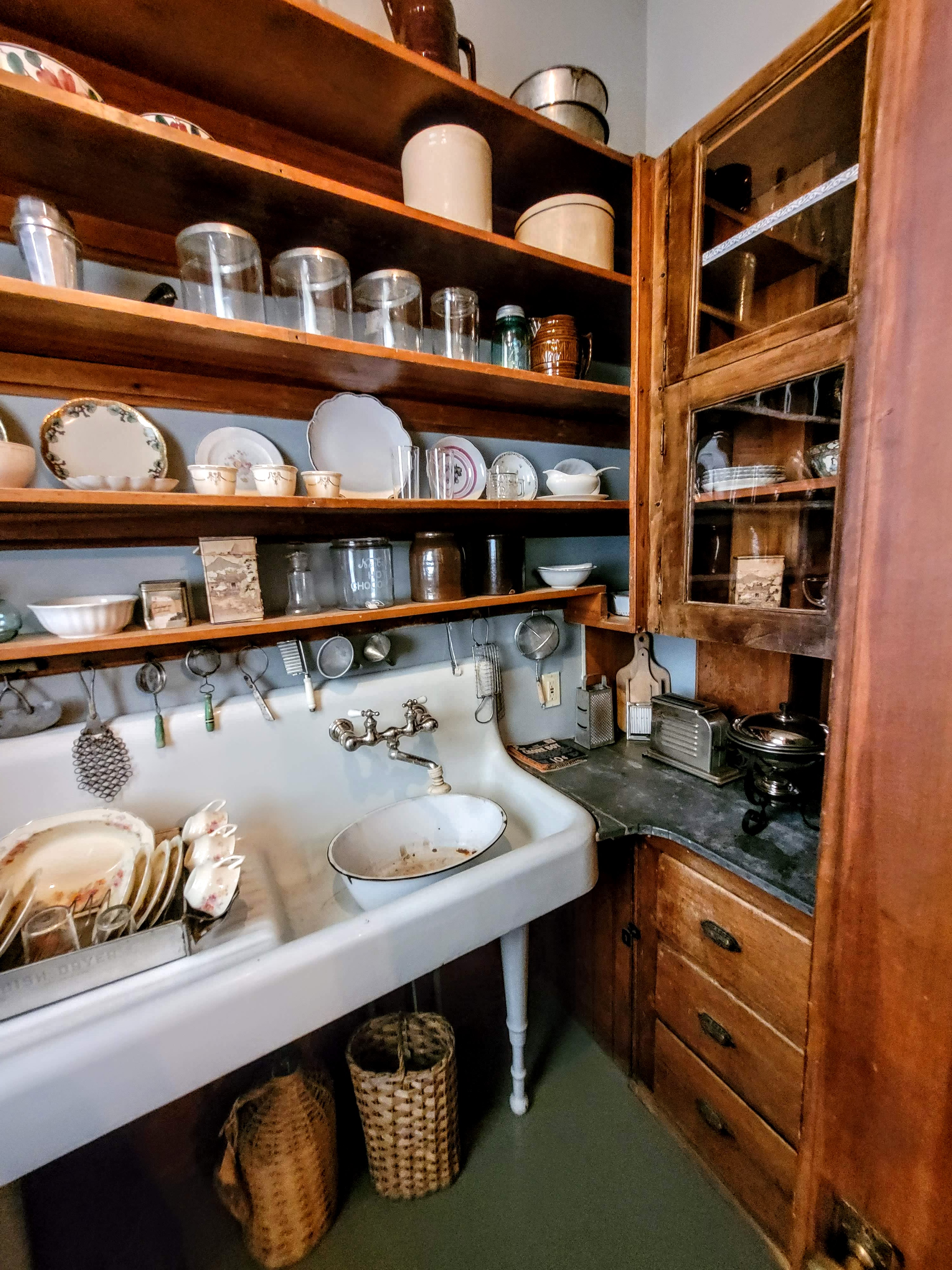
Down the stairs we went... at a cautious pace, the stairs were steep and short, with a turn towards the bottom. Initially there was only one stove, but when the Adams' moved in, they brought their owns stove.

You may have noticed that the bottom stove is electric... one of the first to be produced in the 1920s.

Things have gotten bigger in the last few generations... look at the waffle iron on the electric stove.


A little bit about W. E. Adams. He was community oriented, and a lot of his money went to enlightening others. He did this by creating the Adams Museum. Carol and I walked the few blocks from the house to the museum.

Anyone walking from the house to the museum can stop and read tidbits of Deadwood history.

For example, the Richard Gordon Memorial Park. In 1890 the town government voted and approved the purchase of land for a park to be accessible for public enjoyment. The park didn't come about for fifteen years. In 1911 a fire destroyed a great many buildings on Sherman Street business district. In 1912 construction began on the park. The town of Deadwood received a 10 inch shell from the U.S.S. Maine, with the intention of it being on public display in the park. The park was completed... no shell on display... apparently it had been forgotten about.  In 1977 the park was officially named "Richard Gordon Memorial Park".

Now we jump forward to about 2009/2010, and the shell from the U.S.S. Maine has been rediscovered. In 2012 a U.S.S. Maine memorial is erected to commemorate the 100th anniversary of acquiring the shell.

Continuing our walk, we learn about a gentleman named John Hunter. Hunter was Canadian born, but worked in Minneapolis at various jobs, one being a sawmill. In 1877, John and couple of business partners left Minnesota with a portable sawmill, and headed for Deadwood Gulch, Dakota Territory. The partnership dissolved, with Mr. Hunter buying out his partners. For John it was a small financial setback that would be short lived fortunately. Unfortunately a fire in 1879 on Sherman Street brought his business to life. Because he was able to supply construction material, businesses were able to get back on their feet again. 

In 1883,with his sawmill prospering John Hunter partnered with another sawmill owner named James Fish. With their union they created the Fish and Hunter Company. Over the next 40 years they expanded their business to include mercantile, retail grocery, hardware, retail / wholesale lumberyards, and millworks. They built several brick buildings for these businesses. 

In comes 1936, and they expand some more, constructing a one story brick building for a planing mill and woodworking shop. Things go good until one fateful night in 1961, when a fire destroys the office and grocery buildings, to the tune of $500,000 dollars. The company did recover, however, Deadwood had lost another landmark to fire. In 1990, the city of Deadwood purchased their old one story warehouse building, and turned it into City Hall.

Deadwood was determined to be a good place for the county seat. With that the first county jail was erected in 1877. It was a 30 foot x 50 foot log structure, with a 12 foot high fence around it. In 1882 Lawrence County conducted its first legal hanging, they hanged James Leighton Gilmore.

In 1886 they began building a new two story brick jailhouse. This jailhouse was a 29 foot x 44 foot structure. A little later a wood gallow was erected for hangings. They were back in business dishing out capitol punishment again. In 1894 they hanged the murderer Cha Nopa Uhah, aka "Two Sticks", and three years later Isador Cavanaugh, aka "Charles Brown".

In 1904, the convicted horse rustler Robert Burns broke out of jail doing substantial damage to the jail. The County Sheriff at the time petitioned for a new jail, deeming the jail unsafe. In 1906 they began constructing a new two story brick jail, 34 feet x 50 feet.

In 1974 they built their current jailhouse, which includes an intake and booking room, sheriff and administrative offices, and the Lawrence County Emergency Management offices.

We finally made it to the Adams Museum. This is an eclectic museum, with all kinds of good stuff in it.
So let's go inside, but before we do, let's talk about how much it cost to visit the museums today. The Deadwood History folk put together a package deal, see three museums for the price of two, even beat the military discount.

The museum uses all three floors of the building. We were told by a voluntee at the Adams House to ask them "how did you get the locomotive in the building". The answer to that question was... knock down one wall, fire up up the locomotive, drive it in, and close up the wall... that was simple.
This was the first locomotive brought into the Dakota Territory in 1879 to work the Homestake mine. This guy hauled roughly 600 tons per day of ore, from the mine shafts to the mills. The mining company used this locomotive until 1906, when it was replaced by the more modern compressed air locomotives. The locomotive was moved to the museum in 1932.

Back in 1929 a prospector came to town touting a very large find from his claim. The miner was John E. Perrett, better known as "Potato Creek Johnny". What was the big news from his claim... how about a 7.3 Troy ounce (8 oz. standard ounce) gold nugget.
The nugget on display is a replica. It was made from another nugget found in the Black Hills in 2010, which weighed 5.27 Troy ounces and placer gold, melted into the replica you see.

Moving along smartly... or at least moving on... we found ourselves in an eclectic section. Items ranged from washing machines to horn chairs.
How's this for a washing machine with a spin cycle.
I'm sure many of you have used on of these. What, you don't know what it is... it's a Kodak panorama camera.
I bet you that I was talking a lot of bull when I mentioned a horn chair, but here it is. I sure hope they got some good ribeye steaks from all those cattle.

The morning of September 26, 1879 will forever live in Deadwood history. On that fateful morning a bakery fire turned into a mass conflagration, and destroyed most of Deadwood's commercial district. Why did it happen... because buildings were made of wood, and built too close together. In their resilience, businesses re-opened, like clothing stores, which had sales from vacant lots. The rebuilding process included using brick and mortar for the new buildings.
Upstairs we went.

How much time do you have on your hands after coming home from work? A miner that immigrated from Canada, and worked his entire life in the Homestakes mine since age 14, found time to make furniture. This table and chairs is 4,500 pieces... his biggest endeavor had 250,000 pieces.
A lot of the exhibits were timelines regarding growth around Deadwood, the Dakota Territory, and Native American Indian artifacts.


From the museum we headed to our truck parked at the Visitor Center, and home for dinner.