Friday, March 25, 2022

Your Left, Your Left, Your Left, Right, Left

 Our departure from the Charleston area brought us down to Wilmington, South Carolina area, at MCRD Parris Island.

The campground backs up against the marsh, was a quiet place, and things to see on base. From time to time we could hear the recruits out in the field training.

The area was not always a marine training depot.

As we have known, the Native American Indians were here a very long time before Europeans came. 

This monument is to the French that built Charlesfort in 1562. I know you cannot read the inscription, but here is what it says: "Here stood Charlesfort, built in 1562 built by Jean Ribaut for Admiral Coligny. A refuge for the Huguenots and to the glory of France."

The Spanish and French were in constant battle of the territory from the Carolinas to Florida, and in 1565 King Phillip II charged Pedro Menéndez de Avilés with removing the French once and for all from this area. After routing the French in Florida he made his way to Parris Island to remove the French from Charlesfort. Having accomplished his goal, Menéndez established Fort San Salvador at Santa Elena in April of 1566, and manned the fort with a garrison of 80 men. In July of 1566, Captain Juan Pardo  arrived with 250 men, and Santa Elena was reinforced with a new fort, San Felipe. 

Menéndez began focusing on establishing a presence in the region, by settling farmers and artisans in Santa Elena in 1568. By the summer of 1569 the colony was made up of 193 people, married and single, and had 40 houses. Though the colony was struggling, Menéndez made Sant Elena his capitol for La Florida. In 1574 Menéndez died on a mission to Spain. One of his sons-in-laws took over the position as governor temporarily... things didn't go so well. Under his rein, there were many feuds with the settlers,  and mistreatment of the indigenous tribes, which led to attacks on Santa Elena. After the loss of 30 soldiers, the fort and town were temporarily abandoned. When they fled, all they could do was watch it all go up in flames, as the Indians set it on fire.

This is a panoramic photo of Fort San Marcos today. 

After a year of abandonment, the Spanish returned to Santa Elena and built Fort San Marcos in six days. By 1583 the fort had fallen into disrepair, and a work party of thirty slaves were sent from St. Augustine to do those repairs. There was a moat built around the fort. They actually built a new fort instead, more on the marshlands, with the same name. This was the last fort for the Spanish, and as they left the area, they burned the fort in 1587 to ensure the English and French would not move in.

Menéndez' daughter inherited the title of Adelantado of La Florida (having the responsibilities for implementing royal polices), but ultimately her husband became governor of La Florida.

In 1923, archeologist George H. Osterhout believed that he had found the ruins of Charlesfort (Huguenot), and in 1925 the obelisk was erected honoring the French explorers. In reality, what was discovered was the ruins of Fort San Marcos. It wasn't until 1996 that the ruins of Charlesfort were discovered 200 yards north of the San Marcos site.

We parked the truck an took a walk along their trail. We started at a lookout point, which overlooked the marshlands and the other side of the base. From the lookout we headed down the southern trail passed a marker identifying the location of a lighthouse keepers home, but no remnants of the home are left. Continuing down the trail there are informative placards describing the plant life and animals running around the area. Marching on we happen to march back in time.

This is the remains of a Brewster Buccaneer. The Brewster Buccaneer was a scout bomber, and not to good for that purpose. These bombers were reassigned to training at the nearby Page Field, a 1/2 mile north of its current site. This particular plane crashed, repair parts were scavenged, and the remaining carcass was towed to its current location so it would not be an obstruction to the landing field. We finished the southern loop trail, and headed to the other trail.

This is an overview of the forts I described earlier. The snake looking trail between the forts is what we walked.

The island was purchased in 1715 by a gentleman named Alexander Parris, and overlooks Port Royal Sound (named by the French). The sound is one of the finest deep-water harbors on the eastern seaboard.

The island came into prominence during the Civil War. The Confederates had forts on all sides, but that didn't stop the Union navy from attacking. the Confederacy knew the importance of the sound, so they built Fort Walker on Hilton Head Island, and Fort Beauregard at Bay Point. The U.S. Navy, under the command of flag officer Samuel F. DuPont sailed a massive fleet to the sound. Before the Union navy entered the harbor, Confederate gunboats challenged them for two days before backing off. DuPont was a shrewd commander, sending his ships into the sound in two parallel lines, then splitting one line off to guard against gunboats, the other made circles bombarding the forts. 

This was a huge victory for the Union navy in November 1861. After they captured the harbor, they used it as the headquarters for the Navy's South Atlantic Blockading Squadron, and the Army's Department of the South. This location was strategic for attacking the South. 
* Union - blue, South - red

After the war the port did not got to waste, it grew into a busy commercial port, connecting the coal fields and the port, via a new railroad. Enticed with this opportunity, the Navy chose to establish a coaling station. Throughout the 1870s this station was used to re-coal  Atlantic based ships that regularly anchored in the harbor.

The potential for the island drew the attention of South Carolina politicians (always looking for the buck), successfully lobbying for a permanent military installation. A portion of the island was purchased in 1881 for a navy base. By 1891 marines were stationed here, and in 1915 the base was turned over to the Marine Corp.

Speaking of the Marines, they have a nice museum here on base, so let's head over there. Visitors starting in the rotunda get a glimpse the Corp's uniforms through the years.
It is hard to see the uniform on the left, in the second photo, but that was the female recruit "work-out" uniform, circa 1950s. The wrap-around skirt was to cover their shorts while walking to and from PT.
Today our marines are loaded down with flack jackets, ammunition, water, guns, and anything else they can fit in their uniforms.

The outer hallways on the ground floor contain exhibits relative to the area before the military moved in. With the Navy on Parris Island, they began building a dry dock in 1891, and completed it in 1895. In that same year the first marines arrives on island, a first sergeant, two corporals, and ten privates. They were charged with keeping order among the contractors responsible for building the dry dock. Originally they quartered in tents, then in the fall of 1862 they moved to the coal storage shed. In November 1863, with 20 marines now, they moved into wooden barracks. In 1896 the detachment was formally designated "Marine Barracks, U.S. Naval Station, Port Royal, South Carolina".
After the hurricane in 1893, which devastated the island, the first ship, USS Amphitrite, went into the completed dry dock. The monitor shown here weighed in at 2,800 tons. The dry dock was able to handle larger ships as well. In 1896 the battleship USS Indiana, weighing 10,288 tons, was the largest ship serviced in the dry docks eight-year career.

1897 saw the closing and deterioration of the dry dock, and Congress wanted to build two new dry docks. With the urging of the South Carolina delegates, Congress moved the naval base to Charleston, and built a new shipyard. The naval station was still operating during the Spanish-American War in 1898, and serviced twenty-two ships. After the war the government moved the base to Charleston.

In 1901 Parris Island was nearly abandoned, with the exception of a few marines acting as caretakers. The Marine Corps moved their officer training school to Parris Island in 1909, in 1911 the recruit depot was established. The Navy established a disciplinary barrack in 1911, operated by the Marines. By 1912 the officer school and recruit depot left Parris Island, leaving only the disciplinary barracks.

October 1915 saw the transfer of Parris Island to the Marine Corps, and the recruit depot was re-established, and has been here ever since.

FUN FACT: the top of a Marine officer's cover (hat) is decorated with a "quatrefoil." Folklore has it that it evolved from rope crosses on hats, so that Marines in the ships' rigging could identify their men below on deck. The "quatrefoil" was inspired by the 19th century French uniform.

During time of war weapons are created to harm one another, no different for the Civil War. This is where the Requa-Billinghurst Battery, a 25 barrel gun. This gun was a volley style, which was a
precursor to the modern day "machine-gun." This gun contained 25 Remington-manufactured barrels in a horizontal pattern. The barrels could be loaded all at once, and could be fired such that shot was scattered over a large area. Its firing range was 1,300 yards, requiring three men to fire the weapon seven times in a minute... in other words... 175 rounds per minute. Below is the clip used to arm the gun. There was only one firing pin, which hit the center cartridge, then sequentially triggered the cartridges both right and left of the center cartridge. 


The designer of the gun has an interesting 
tale to tell. This is a photo of Dr. Josephus Requa. At age 16 he was an apprentice gunmaker under the direction of William Billinghurst. After several years though, he changed professions to become a successful dentist. But in 1861, he realized that that the Union was going to need some type of rapid-firing gun, so he designed one, and completed a prototype. In 1862, Requa and Billinghurst patented the multi-volley gun, and presented it to President Lincoln. There is a lot of history pouring through this museum, but we are going to go to the other wing... recruit.

On the ground floor to the right, is where visitors learn the life of a recruit.
The first stop for a recruit after stepping off the bus is:


After they make their way to the painted foot steps, they enter doors, similar to the ones on the left, known as the silver hatches. inside those doors is a room full of chairs and tables where the recruits will complete induction information, and make a call home letting families know they arrived at Parris island safely... this is NOT a social call... they have a script they MUST follow. At this point civilian life ends, and military life begins.

As recruits they spend a lot time in classrooms learning: Marine Corps history, rank structure, culture, insignias, customs and courtesies, 11 General orders... and much much more. Don't forget, they also get to play in the sand. Another important piece of their training is memory muscle exercise, better known as "drilling." From the first night they stepped on the "yellow footprints", they begin to learn about teamwork. Everyday they drill on the "grinder", learning commands and movements, showing off what they learned during graduation.

Their training on the "grinder" is evaluated twice before graduation. In the final evaluation, the recruits are evaluated on bearing, discipline, attention to detail, and the ability to lead the platoon.

Recruits will participate in IT (Intensive Training). This training is designed to build discipline, motivate, and correct any minor infractions. The Drill Instructors must follow the guidelines for IT. IT was created by Certified Athletic Trainers, and designed to build stamina and strength, as well as the above mentioned.

The reason for all the physical and mental training is to prepare them for the "Crucible". The task they must endure requires sleep deprivation, and a long march, culminating in the raising of the American flag and receiving pins.

The Marines have put out some fine folks back into the civilian world, people like:
Robert Remus, Sgt. Slaughter (WWE wrestler)
Leon Spinks (Boxer)
Patty Berg (legendary women's golfer)
Robert James Keeshan (Captain Kangaroo)
Hugh Brannum (Mr. Green Jeans)
John Glenn (Astronaut)
Bea Arthur (actress)
Tyrone Power (actor)
Drew Cary (actor, game show host)
Lee Trevino (legendary golfer)
... just to name a few.


Tuesday, March 15, 2022

The USS North Carolina


 We took a drive to Wilmington to visit a veteran warrior.


The Navy has a long tradition of reusing ship names, honoring the ships with grand records of service. The name North Carolina is no different, there were/are six ships that proudly honor the name:

Ship-of-the-Line NORTH CAROLINA (1824-1867)

Confederate Ironclad NORTH CAROLINA (1863-1864)

Armored Cruiser NORTH CAROLINA ACR-12 (1908-1921)

Battleship NORTH CAROLINA (BB-52) (1919-1922)

Battleship NORTH CAROLINA (BB-55) (1941-1947)

USS NORTH CAROLINA (SSN-777) (2008-    )

There is a lot to see, even with the restrictions as to where visitors may go. Visit: https://www.battleshipnc.com. They offer guided tours which open up spaces not available to visitors like Carol and I.

After purchasing tickets, visitors can begin their tour in the lobby area. Besides history on the previous North Carolinas, they had one of the fanciest silver service set.

The citizens of North Carolina presented this 120 piece silver service to the cruiser North Carolina in 1907. You need to be there in person to see all the design work, and detail. 


Engravings include: a nautical rope, cotton bolls and tobacco plants, long leaf pine bows, dolphins, fish, seashells, North Carolina state flag, Union Jack, etching of the Cruiser North Carolina, etching of the state capitol, and the Department of the Navy seal. 

From the lobby visitors head out to the battleship. At the time we visited, part of the port (left) side was taped off for maintenance on the mast, nothing was missed, there were alternate routes to the accessible areas. The ship tour starts by boarding the ship aft (back of the ship), port side.

Battleships were unique, in that they could launch and recover a plane, known as a scout plane. On the North Carolina it would have been the Vought-Sikorsky OS2U-3 Kingfisher floatplane. The float planes were launched via a catapult system, and fairly simple
getting off the ship, returning was the challenge. To recover the plane, the ship would turn in such a way that the wake they caused would create a slick for the plane to land on. The ship would
then tow a sled alongside for the pilot to taxi his aircraft onto; once on the sled the pilot would cut his throttle. A hook on the bottom of the plane would engage the sled so that the plane was traveling at the same speed as the ship. Once secured on the sled, the crew would attach a hook to the plane, and raise it via the ship's crane. The bottom photo is courtesy of the Naval Air and Space Museum.

Turning around from the plane storage area, something big is pointed toward you. These are 16" guns capable of firing projectiles a long distance...
how about 21 to 23 MILES. Each barrel is 60 feet long. Each of the three turrets required a lot of man power, 3 officers and 177 enlisted... PER TURRET. Let's talk how much time it took to fire a round...30 seconds. Imagine pushing a 1,900 pound (high capacity), or a 2,700 pound (armor piercing) projectile 23 miles... that's something amazing. How about the turret itself. The rotating turret is protected by 11 inch thick armor plating and enclosed in
a 16 inch thick armor plated barbette, down to the second deck. All the visitors see on the main deck is the rotating turret.

Visitors are allowed to climb in the turret and see the cramped spaces the crew had to work in. 

The first photo is the center of the turret. To go up those steps, you needed to lean over if you were taller than 3 1/2 feet. The next little cubby was the man responsible for getting the powder and projectiles to the loading area, which you see in the third photo. Shell in first, then powder. Remember, it took 30 seconds to fire the projectile, sometimes faster. I didn't mention earlier, the turret could rotate 180 degrees in 45 seconds.
The last photo shows the six bags of powder being rammed into the breech by the rammer man, the primer man inserts a primer into the last bag, the breech is closed and locked, and the green ready light is turned on signaling the turret officer that they are ready to fire. There were a lot of guys making thing happen in the upper turret, two officers and 13 enlisted. 

Now that they have finished firing their weapons of major destruction, its time to what... clean the barrel. This is where the skinny guy
comes in. The skinniest guy usually got to clean the barrel... and all gun enthusiasts know the importance of a clean barrel. I will offer you the story of Chief Gunner's Mate, Paul Phillips: "Several times I was asked to put on canvas coveralls. The first step was to get two lines from the chamber all the way through the barrel with the gas ejector. Then I would lie on a canvas hammock and secure a line to each corner. I would tie a rag around my head and enter the chamber feet first. Someone would pass me a rag and a pound of grease. When I said "ready", men on deck would start pulling me through (the barrel). I was glad when my feet came out the end. 

We followed the tour path, continuing on the main deck. For those not familiar with Navy terminology, the main deck is the first deck that traverses from the bow to the stern (front to back, or fo'c'sle (forecastle) to fantail)). 

This is a 1.1 inch quadruple barrel anti-aircraft mount. This gun
was originally mounted above the main deck, but mounted here for the visitors opportunity. Believe it or not, this little gun required a 15-man crew. The effective horizontal range was 3,000 yards, pumping out an average of 100, 1.9 pound rounds per minute. This gun went into production in 1934, but large quantities did not become available until 1940, and by then they were inadequate for the planes flying. The other problem, which took a toll was... jamming when overheated.

We are now going to head to the fo'c'sle (long "o"). Did you notice the deck we are walking on, it is teak. Teak was a hearty wood for seagoing vessels. Deckhands (Boatswain's Mates) were scrubbing this deck everyday. The reason
the fo'c'sle is metal at the very front has to do with chains and anchors rattling around. Let's talk about  the anchor and chain. 
Each one of the chain links, about 12 inches in length, weigh 80 pounds a piece x approximately 300 fathoms (six feet per fathom). Ships carry two anchors, but generally only one is used when a ship is at anchor. If rough weather is expected, they may drop the second anchor to improve their chances of staying anchored.
Big ships require big anchors, and this anchor weighs in at  25,883 pounds x two. It doesn't look like there is room for 300 fathoms of chain on deck does there. The answer is a chain locker. There would
be a locker for each anchor chain. Have no fear about losing the anchor, the bitter end (end of the chain) is secured in the chain locker.


During time of war wanting to protect harbors, mines were laid. Navies have always tried to destroy mines, before they destroyed ships. WWII was no different. The battleships carried onboard a device, the paravane. The purpose of the paravane was
to cut the cable of moored mines. For operation, the paravane would have been set out from the side of the ship, at a depth that was five feet below the keel's (bottom of the ship) depth. Lines from the bow towed the paravane, and when a mine cable came in contact with the tow line, the mine cable slid up the tow cable, and at the end of the tow cable a serrated tooth cutting device, would cut the mine cable. Just so you understand, the paravane was set away from the ship by approximately 20 feet.


Back to the aft section of the ship so that we can enter the bowels of this vessel. While the engineroom and fireroom are the heart of the ship, there is another that needs attention... feeding the sailors. 
Back in the day most of the food was real, very little out of cans. The photo to the left was the prep area for vegetables, and below is the butcher shop. These were preparation areas; the produce, meat, and dairy were stored on

the refrigeration deck. Three reefers were for meat, two for fruits and vegetables, one for eggs and butter. The refrigeration deck also contained a thawing room, refrigeration machinery room, and ice maker. The ship was designed to carry 90 days of provisions, however, in January 1944 they were ordered to carry 120 days of provisions. Because of the requirement to carry more provisions, they were required to take on more canned products, including meat. Once the food made it to the prep rooms,
the cooks went to work making it ready for the crew. In the front you can see the dough machine for making rolls and bread. The coffers boiled the veggies, and then in another area the griddles were hard at work cooking lots of meat. In the morning the griddles would be churning out eggs, bacon, and hash browns.

If you have ever eaten at a buffet, it was not much different than eating on the mess deck. Climb in line, grab a tray, silverware, and head to the serving line.


The mess deck was the communal area on the ship. Besides eating, camaraderie
 was built playing games and cards, and socials, which we get to later. Eating on the mess
deck was sometimes like eating at a crowded McDonalds. A lot of ships had a pecking order for the chow line, usually watchstanders having head-of-the-line privileges, so they could relieve the standing watch on time. The mess deck is no different than eating at home, you dirty dishes, they need to be cleaned... the answer...scullery. The scullery was a hot happenin' place, but not 


for partying. Personnel from each division worked the scullery, as they were voluntold, serving on the mess deck for at least six months.

Did you ever wonder what was done with the food waste?
All food waste was ground up and sent overboard as fish food... hence, the grinder.


The mess deck served another purpose all together different than the afore mentioned... 
throughout the mess deck you could find hammocks that functioned as overflow berthing. During the day personnel were not to be in their rack, or hammock, unless they were the late watches, or on the binnacle (sick or injured) list. I mentioned that they had socials... ice cream, from time to time. The ice cream parlor/soda fountain was
just like back home, choice of ice creams and toppings, and possibly a couple of varieties of sodas... for the floats of course. During my time on ships we didn't see ice cream very often, as it took up a lot valuable space for the rest of the provisions. This battleship, and probably 
others, had the ability to make their ice cream as needed. I didn't take a picture of the machines that supplied milk, they were nothing like the ones you see at a buffet, they were large coffer-looking contraptions. My guess is that milk was stored in the containers that came from the dairy, then poured in the machine.


The mess deck also served as the ship's store. The sailor could get just about anything he liked, with the exception of alcohol. The store stocked all the rating badges that the ship was manned with. If the sailor was lousy at sewing on his new rank, they could take their uniforms to one of the three tailors onboard. The tailor shop
also offered alterations, sewing of the rating badge and hash marks, and pressing and cleaning. Most of these services were free, and any monies collected, went to the welfare and recreation fund. Something else we never had on ship... cobblers. For you that are unfamiliar with cobblers, they repair shoes. One cobbler was
assigned to the ship. Most of his repairs were free, with the exception of half soles, and rubber and leather heels. In the Navy of my day, sailors were provided an allowance to purchase new shoes, but some rates (jobs) could get their shoes replaced through the supply system, I happened to be in one of those rates, working on the flight deck.

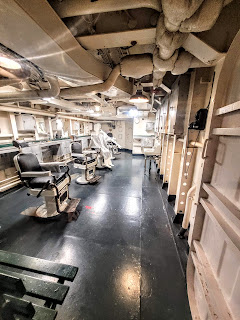
You couldn't go into war looking shaggy, so the Navy stationed barbers onboard ships. In the case of the battleship, four chairs,
minimal wait. You could get your hair cut in any style you liked... as long as it was the Navy's required style.

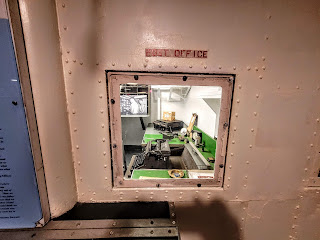
As you might be able to tell by now... a ship was a little city... in a big sea. The crew were not totally isolated from the world though, they did receive mail periodically. All ships had a post office, and the ship had its own address.
This little opening was a sailors access to home. Each time the ship hit a port, the sailor was hoping to hear from his family. 

During my days, the ship would hit port, and there was a working party to carry the mail bags onboard. 
On my first ship I remember working alongside our postal clerk, because we were in the same division, emptying bags and sorting as quickly as possible. The mail petty officers for each division were standing outside the window for mail. It was always a clamor to be the first mail petty officer to pick up mail. The reason I assisted with the mail... I ran the TV station... and programming material was part of the mail. In the early days TV programming came in cases that were 10"x10"x10", weighing about 20 pounds each, and always at least seven cases per week of programming; sometimes I would receive multiple weeks of programming because of our schedule. Then there was returning my old cases, which could be several weeks worth. Mail was an important morale booster in the day.

What would a ship be without stinky sailors... a clean smelling ship. 
Imagine sharing you bathroom with 142 other guys. If you require privacy to take care of business, you would have needed to learn real fast how to focus on your task at hand, especially when it came to #2. Privacy... not.

You'll probably notice the sleek design of the toilets. By the time I made it to ships, they had stall doors, and regular toilets. Generally the busiest times were in the morning after reveille, and before taps.

You may remember me talking about not being able to visit one's rack during the day, with a few exceptions... here's why. Usually about 0600 (6:00 am) sailors would hear HEAVE OUT AND TRICE UP at reveille. That meant, get out of bed, make it, and stow it away.
There are six racks in that oval, they would be easier to see if the mattresses were on them. The mattress was no more than a four inch piece of dense foam, with a mattress cover. Looky below.
The reason for tricing up racks, it allowed the compartment cleaner the opportunity to clean the compartment thoroughly, which included the head (bathroom) as well. Sailors within their specific division were voluntold for these duties, usually lasting six months too.

Battleships had a lot of personnel to keep it operating, and part of that was keeping things laundered. These bigger ships had more in the way of dealing with bed linens, mess linens, and uniforms. Not everyone
was fortunate enough to have pressed clothes. Here the services were applied to officer's uniforms, sick bay bed linen, Officer's Mess linen (tablecloths and napkins), Chief Petty Officer's Mess linen (tablecloths and napkins), Barbers' shirts, Cooks', Mess Cooks' and Bakers' uniforms, hats and aprons, Marine detachment khakis, and Steward's Mates' uniforms. If you were in one of these categories, pressing service was available, but not free. The charge was included in a monthly "finished service" fee that officers, chief petty officers, mess cooks, bakers, and galley cooks paid.

Now if you knew someone that knew someone, you might be able to trade services, and have a guy in laundry press your uniforms. For the less fortunate there two other options... put your uniform under your mattress and sleep on it, or create a makeshift ironing board and iron away. Laundry was part of a rate, but was sometimes 
augmented by a personnel from other divisions. Laundry was a 24 hour service offered to the ship's crew. The men working in the laundry worked in two man teams, in 12 hour shifts.
For those that may never have been stationed on a ship, let me provide a little insight. In the berthing compartment laundry was sorted by blues and whites, this done in a laundry locker where two canvas bags hung, one for blues, one for whites. That guy cleaning the berthing, was the guy that dragged multiple canvas bags down to laundry, and dragged it back up. 

I know you ladies might have some problems with the drying process on ships, it was very much like the way clothes were dried on the farm. You guessed it, laundry was washed, and sent back to each division for the sailors to find a way to dry it... this applied to first class petty officers and below... chiefs and officers had there clothes dried.

A memory from a North Carolina sailor. "We used to hang our dungarees over the side to bleach and soften them. We also worked a deal with the laundry guys to starch and press our shirts. This worked out pretty good until some of the officers complained we were looking better than they were, so we had to buy an iron and do it ourselves."  Harold Smith, Fire Controlman 1/c. 

Back in the day of this battleships, there weren't computers and printers, so the ship was equipped with a print shop.
The shop was responsible for: ship's newspaper, menus, Plan of the Day (schedule of events for the day), letterhead, liberty cards, ship's newsletters, maps, and plans for attack.

All that paper that was generated... what happens to it when it is not needed any more. Like all garbage went to the grinder, all paper products went to the incinerator.
Paper products were separated into either paper or cardboard. There was usually one person working the incinerator room; during general quarters the incinerator continued to burn. When they were ready to dispose of the ashes... soaked in water, they went over the fantail, in the wake of the ship.

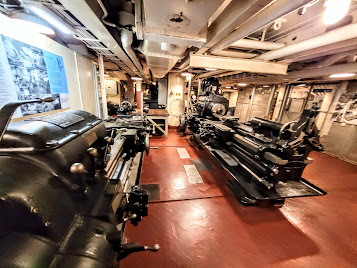
I told you earlier that a ship is a city to itself when at sea. When something breaks, it is up the machine shop to fix it, or build it.
In a machine shop one could find milling machines, drill presses, lathes, and other assorted machinery needed to repair or replicate parts.
During my time in the Navy I had the opportunity to work with the MRs (Machinery Repairmen). They let me do some of the small non-critical parts, but most of the time I would engrave name tags and placards.

Staying with the "little city". If there is a fire or flooding, it's up to the ship's crew to handle it. 
The wood stored here was used to shore up leaks in the hull, or sections of the ship that were collapsed. When shoring up, the wood needs to be cut to size... using hand saws. Before installing the wood braces, sand was laid on deck to prevent the wood
from slipping. On the battleship they used the mechanism on the left for counter flooding. The ship has 63 voids that can be flooded with 40 to 60 tons of seawater... in six minutes. The system on the North Carolina was put to the test September 15, 1942, when they were torpedoed. The last photo is a Damage Control (DC) Locker. There are multiple DC lockers on a ship, not knowing where damage can occur; the lockers have areas of responsibility. From the DC locker, damage is documented, information passed to Damage Control Central and the bridge, and where personnel are sent from to conduct repairs, whether fire, flood, or biological/chemical attack.


Let's get back to creating damage, its more fun. 


What you are looking at is part of the process for sending rather large shells 23 miles away. Looking at the second photo, you can see the tips of blue shells, they are training rounds. The yellow and green are the ones that are lethal. For those rounds to hit their target you need powder. The "cut out" operator in photo four is responsible for getting product to the desired locations. The last photo is one of the powder elevators. The powder handling was pretty interesting too... are you ready.


The cannisters you are looking at contain three of the powder bags you see on the loading tray. This process was well orchestrated.

It moves from the magazine side to the elevator side, where another person begins the bag's trip to the barrel. The operator on one side, in the magazine, turns a knob and the operator on the other side of the powder shuttle, sees the same command. 
This is the elevator that powder and shells travel up to get to the guns. This trip travels about five decks, helping the guys in the upper turrets to fire shells at that 30 seconds per round pace.


Here is an example of times changing. The first North Carolina would have fired something like the projectile on the left. As time moved on the projectile got bigger, and

required a bit more powder. By WWII the projectiles were weighing much more, needing even more bags. WWII projectiles required six bags of powder. It was interesting to learn about the bags and powder too. The bags were made of silk, because silk is strong, burned quickly, free of acids that could react with the gun powder, and left no residue in the barrel which might cause premature detonation of the next round. The projectiles required two types of gun powder, smokeless and high explosive. The way it worked: smokeless powder forced the shell out of the barrel, and the high explosive powder is needed to ignite the smokeless powder... who knew.

The guns were much more fun thanks to the Gun Control Center, located in the bowels of the ship... and it was available for touring on our "regular people" tour. This setup was very
commanding with all the equipment in the space. The control center was responsible for:
 
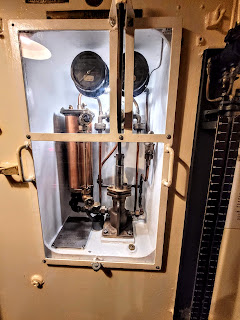
This was an important piece of equipment, called a Stable Vertical. It contains a gyroscope that monitors the roll (side to side) and pitch (up and down, forward to aft) of the ship. The information went to a piece of equipment called the Rangekeeper. From the rangekeeper it made to the plotting room tables.
 
During general quarters this place would have been hoppin'. Imagine yourself at a wedding reception, everyone talking at once, and you're trying to order something to drink... at the top of your lungs... multiply that about three times. The amazing thing that happens in that kind of situation, each person learns to hear the information that applies to them.

With this kind of excitement, there is sure to be casualties. All ships had some form of medical team on them. The bigger ships, like battleships, had a surgical suite.
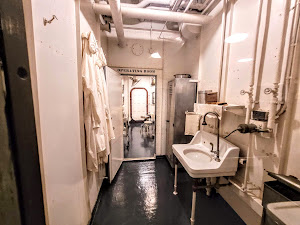
With any hospital surgical suites there is a scrub room to go with it, no different for the North Carolina. 
For day to day medicine, there was sick call, and the opportunity to get medication at the pharmacy. 
The pharmacy wasn't anything you are use to today, they made their medications.


Bigger ships also have the opportunity for dental services.
The dental office has three chairs, and handled everything from routine care to oral surgery. You required an appointment to see the dentist.

Here is another crew members memory: "The ship's dentist pulled all four of my wisdom teeth same day. I had no pain. For thanks, and since I was a butcher, I made him a beef steak sandwich. The steak was tenderloin... no better meat than that". Lincoln Hector, Ship's Cook 1/c. 


This was a fun experience, and there is so much more to see on the ship. As always, I encourage you to visit their site, or even come see the ship in person.