I promised you a lighthouse in the last post, sorry for the fib.
So here is a lighthouse, Cana Island Lighthouse. It was a bit interesting getting to this lighthouse, it is technically located on an island. Visitors have the option of walking, or riding a hay wagon pulled by a tractor... we chose to ride the hay wagon.That beautiful white haze is the smoke from Canada. What you are looking at is the access to the island, across a causeway. Looks pretty easy you say, today it was. Depending on the waters of Lake Michigan and the wind, there could be three feet of water covering the causeway. In fact, as we were returning after our visit, the water was beginning to cover the causeway. The stopping point for the hay wagon is at the visitor center/gift shop, from there it is a 200 yard walk to the lighthouse.
This photo gives one a perspective as to what had priority. The little tan brick building is the two-person privy, the white structure is the oil storage.
This structure housed the oil barrels containing the kerosene used for the light. Here is a bit of a surprise for some folks, in 1869, when the lighthouse first lit, they used lard. The earlier lighthouses used whale oil, but because it became expensive, the Coast Guard found the need to find a different fuel. Lard was readily available from the local butchers.Lets talk about the next form of lighting the lamp, kerosene, and mineral oil. Because the kerosene and mineral oil were so flammable, they were stored by the boathouse across the island.
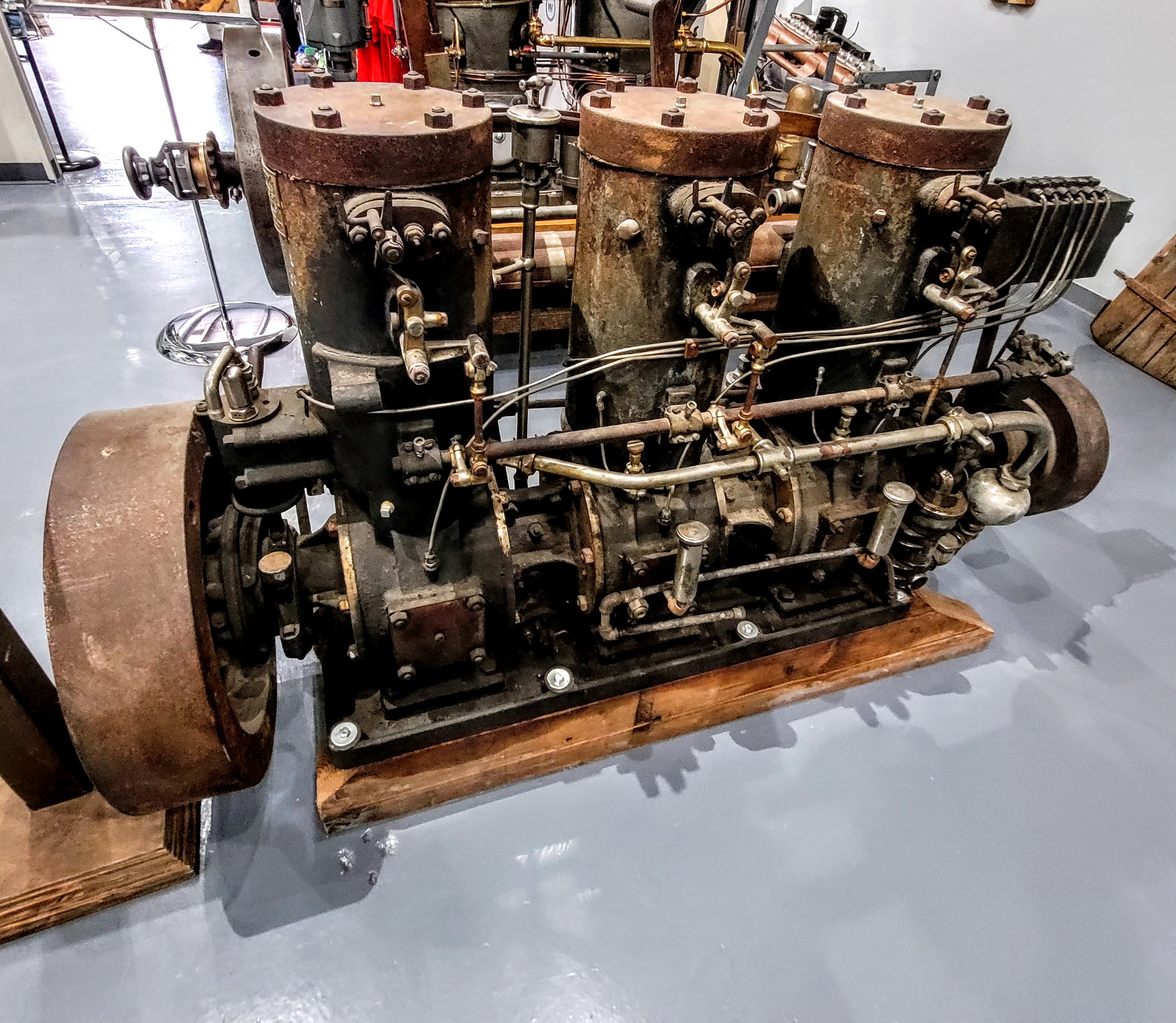
Around 1925 the light keeper moved the kerosene and mineral oil tanks closer to the storage structure, and ran a line between the structure and tanks.In 1934 the Lighthouse Service was considering running electricity to the lighthouse; one estimate was for $13,400.00, which was equal to $245,329.00 in 2018. By 1939 the Lighthouse Service was absorbed by the Coast Guard. The Coast Guard again looked at cost to electrify the lighthouse, and received an estimate for $2,500.00 ($45,770 in 2018 dollars). The design involved the installation of two or three engines and a battery. Evidence indicates that they went with two engines.
Looking in the Fresnel lens today, all visitors will see are small filament light bulbs. In the photo you can two sticking out, one to the right, the other to the left, but only one lights at a time. In actuality, there are four bulbs, and when one bulb burns out, the mechanism rotates to bring a good bulb into operation.
I did not intend to start at the top, so back down we go.
The yellow brick structure is the Light Keeper's house. Originally the lighthouse was made out of the same brick as the house, but weather started causing deterioration, so it was clad in metal.
Here are some notes about this particular lighthouse:
Built: 1869
Height (to top of the lightning rod): 89 feet
Light Height: 85 feet
Focal Distance: 18 miles.
Steps: 95
In the 75 years the lighthouse was manned, there were 9 Keepers, and 23 Asst. Keepers.
The keeper's house was recently restored.Originally the keepers house was designed to be two living quarters, one for the Keeper, the other for the Asst. Keeper.
Lets just say it didn't happen that way with the first Keeper, who brought his wife and five children. They took up both floors, thanks to his wife being named the Asst. Keeper.
The first floor consisted of the mud room, family room, kitchen, the Keeper's office, and a bed room; there was also access to the lighthouse from the first floor.
The second floor was not quite as fancy.
Along with the three rooms for the assistant, there was a kitchen. The other obvious room missing is the... bathroom, remember, it is located outside near the oil storage structure.
Asst. Keepers were usually young single men, because they did not have much. The Lighthouse Service also preferred the young single men because they could assign them wherever they might be need. Only when there was a shortage of applicants would the Service look at wives and older sons of the Keepers family.
The children didn't just roam the 8.7 acre site aimlessly, the boys would help with chores around the campus, and the girls usually helped their mother.
Enough about the laborers, lets labor ourselves by...95 steps to the light. The handrail you see in the photo did not exist when the tower was first built, it took several years before someone decided it would be a good idea to install it. Think of yourself as the Keeper or Asst. Keeper carrying buckets of lard, mineral oil, or kerosene up those steps every day, possibly multiple trips. This trip was not one of great excitement for me, I am uncomfortable with heights... just wait until we get to the top.I'm ok, this is the view from the first landing port hole. Up we continue.
Still ok, third landing, we are still inside the tower, but it can't last much longer.
NOT MY COMFORT ZONE. My back was up against the tower wall, only grabbing the rail to continue around the tower. I was very happy to step back inside the tower again. The second photo shows damage from a duck. It is believed that the duck was blown into the outer glass housing, which caused damage to the Fresnel lens. Speaking of the outer glass, it was the responsibility of the Keeper, or Asst. Keeper to keep the glass clean. Daily they had to climb a hook ladder, from the outside of the tower, and clean each window. NO THANK YOU!!
We made it back down the 95 steps to the comfort zone.
WRECKAGE FROM THE M.J. BARTELME
Last stop on the way back to the information center. This is the workshop/barn, built in 1885, and restored in 2017.
In the information center/gift shop there is a short video, and a timeline of the lighthouse.
CANA ISLAND AND CAUSEWAY TO ISLAND
We made it safely back to the truck to begin our trip back to the trailer.
When Carol and I travel we try to find events or attractions that are local to the region we are visiting. As I have mentioned before, here in Wisconsin is cheese, in Door County is cherries, and... fish boils.
In this area the idea of fish boils came about through the Scandinavian immigrants. The area was filled with logging communities, and the folks were trying to figure out how to feed the masses, a community feed was the answer. Today the process has become a show, as well as a feast. Carol and I decided to visit one.
We drove to Fish Creek, which was about 7 miles from our campground, and managed to find a good, shaded parking spot on the street, almost in front of the restaurant we were going to visit. Whichever restaurant one visits, they recommend that diners show up about an hour earlier than their reservations, that way they get to see their food cooking. Our restaurants sat at the base of a bluff, which was particularly nice in that it was not too windy eating outside.
Yes, there are houses on the bluff, through the trees.
It doesn't look like much when I took this photo, but this is the arena where the show becomes a meal.Notice that the chef has inserted the stainless cooking vessel, and added wood under it, and around it. While the chef is preparing the fire, the audience can ask questions. One of the questions asked pertained to the wood planks on the outside of the cauldron. The function of the planks is to keep a steady temperature on the cauldron during cooking. By moving the planks he can maintain temperature, functioning much like an oven door.
In the cauldron is about 35 gallons of water, with a pinch of salt added; that pinch of salt is a one gallon pitcher. During the boil he will use 10 pounds of salt.Once the water get to boilin' the chef will add the potatoes, and another pinch of salt (ice scooper). You may be asking yourself, how will he do that... answer... stainless steel basket.The big baskets hold the potatoes and Texas sweet onions, there is a smaller basket that fits inside the bigger one, and it is for the fish.
We now have potatoes and onions cooking. The potatoes were started first because of their cooking time, then the onions were added. After about half an hour cooking, the fish is added...This is locally net caught fish, called Whitefish, caught straight from the waters of Lake Michigan/Sturgeon Bay. The fish are classified by size, and range up to jumbos. Most of the fish boil restaurants use a class one, which nets about three good steaks per fish. Once the fish go in, its about another 15 minutes before the dinner bell rings.
I do not mention the dinner bell lightly. When the bell is rung, it is time for boil over. Boil over is the process by which the chef removes the oil that is riding on the surface of the boiling water. Ah... how is boil over achieved... a #10 can of diesel fuel, or kerosene. The fuel is poured on to the fire, causing the water to boil over, spilling all the oils off the water's surface.Was that great or what.
End result of the boil over...
I had the manly serving of two portions of fish with my dinner. To give you an idea as to how good it was, Carol, the not a fish lover, ate her entire portion of fish. As you can see, there was fish, coleslaw, potatoes, onion, and corn on the cob, slices of white and rye bread and butter, and a nice portion of Door County cherry pie for dessert.
I will tell you this, one needs to know the secrets for removing fish bones. The only thing that happens to this fish after its caught, is that it is cleaned. This light tasting fish was easy to debone. Find the backbone and gently pull the fillets off the bones, that gets most of the bones out of the way. Carol and I would do another fish boil.
MORE TO COME OF DOOR COUNTY