We got out of Colorado Springs before it snowed. It didn't last long though, we saw light snow flurries around Denver.
This formation is at a town near Denver, and is called Castle Rock, which the town is named for.Like I said earlier, the flurries were upon us around Denver, but once we got further north, they weren't flurries anymore.
The flurries changed to down right snow, and continued most of the journey to Guernsey, WY. The drive itself was good, there wasn't much wind to speak of, just made a mess of the truck and trailer.
Our first two nights here were down in the teens, with a wind chill even lower, needless to say we didn't do much running around during the days either. We did get a dusting of snow the second night.
Once it warmed up, and the winds died down we journeyed around the countryside. If you looked on a map of Wyoming, it wouldn't show much around Guernsey/Wheatland area, but we found sites to see.
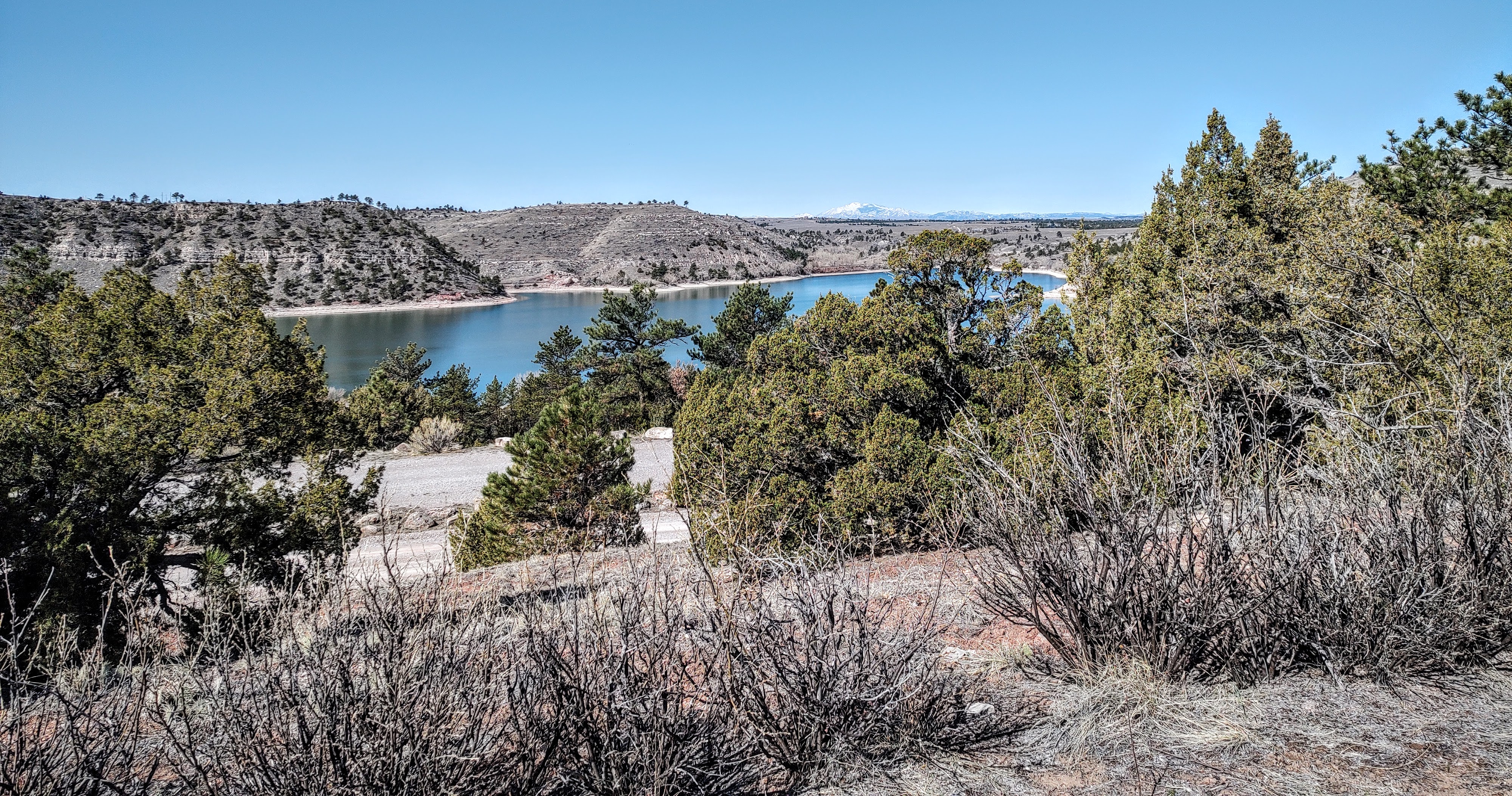
It was a 13 mile drive to our first adventure, Guernsey State Park. The park is around Guernsey Reservoir.This is a view driving over the dam. There are several campgrounds around the lake, and a museum. Carol and I drove through the campgrounds, most of them are designed more for tent camping and small RVs, and they are dry camping with restrooms and local water faucets.
Our first stop was up a winding road to the museum. Thanks to the Civilian Conservation Corps. (CCC), structures in this park were constructed between 1932 and 1936.
The museum is a prime example of their craftmanship, built from stone and timbers. The museum was hand-crafted, the roof is hand hewn-timbers and split cedar shakes. The floor is made from flagstone quarried in Thermopolis, WY. the front doors, and paneling in the library are "pecky cedar" from Florida. It took approximately 6100 hours to complete, at a cost of $3,200 in mid-1930s. Ready for the reveal? 

The complete trip around the one side of the lake goes to the other entrance to the park, and into Guernsey. Just to make it clear, Guernsey is not a big town, they only have 1,100 residents. One thing going for Guernsey today, they are near the Oregon trail. Drive through town, make left, drive a couple of miles, and you can visit this state park. The notoriety of these cliffs, they were signed by pioneers traveling the Oregon Trail.This rock is said to have approximately 700 names from the old days, now there are a lot of new names too. At one point there were Native American Indian petroglyphs and pictographs, now covered by names. In the fenced area of the photo, is a cemetery of those that did not make it past this point. These were the earliest names Carol and I could find...
Henry Fredericks gifted the cliffs to the state in 1932, and through the generosity of the Fredericks family, it was open to the public in 1970.
What was this used for? Many years ago the Fredericks blasted a hole in the cliff, to use it as a root cellar.
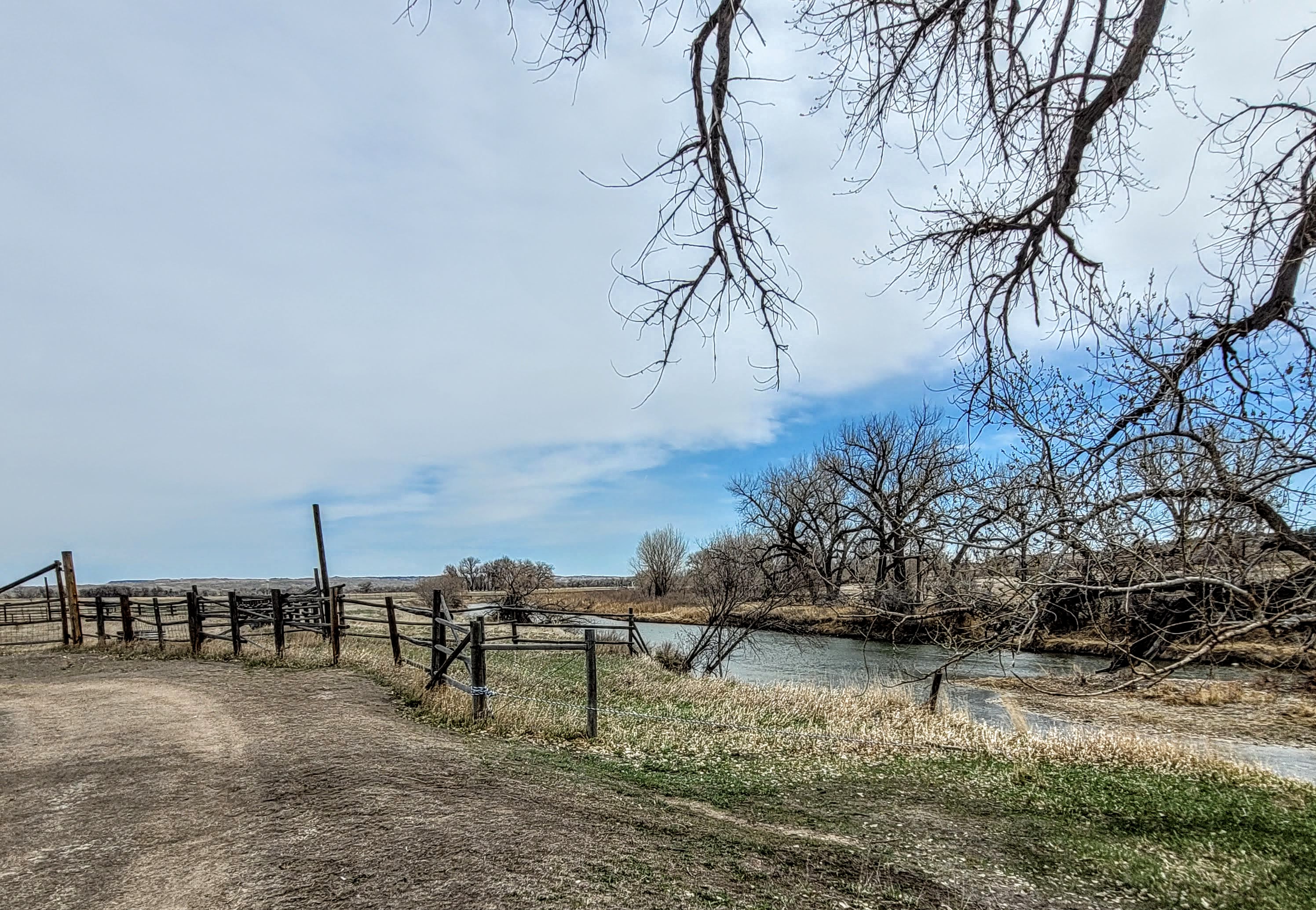
After spending a few minutes at Register Cliff, we back tracked a couple of miles to visit some ruts in a rock. These ruts are reportedly wagon ruts from travelers on the Oregon Trail.This is another part of the state park. The walking loop is about a 1/2 mile, part of which appears to pass next to the Oregon Trail.


This appears to be part of the trail the wagons passed this area on.
On the last nice day in the Guernsey, we took a drive to Ft. Laramie.
We were really surprised at how much was renovated.
Ft. Laramie didn't start out Ft. Laramie, it was first called Ft. William. But first...This is where the tour begins, the Commissary Storehouse, now known as the Visitor Center. The visitor center contains the timeline for the fort, and offers a short video about the fort.
This would be Ft. William, 1834 to 1841, made out of logs, and only 80 feet by 100 feet. It was not built to protect against Indian issues... how about that. You see, back in the early 1830s, mountain men roamed the land, and traded with the Indians. The reason for the fort was to contend with the big fur trading companies trying force each other out of the region.
Later in 1841, the fort went through a renovation, including a name change, to Ft. John. This update was necessary because of a competitor building Ft. Platte. The new fort was larger, and was adobe, vice logs. This fort lasted until 1849.
As the fur trade was declining, the fort was sold to the government. The government turned the trading fort into a military post. The above photos were the fort from 1849 to 1859.
What was a small trickle of emigrants moving west in the early 1800s, became a flood by the 50s, scarring the land, killing game, and scaring off the rest of the wildlife. These problems hampered the way of life for the Indians. The emigrants were desiring good relations with the Indians, so a peace treaty was signed in 1851, securing safe passage along the trail, and compensated the Indians for their trail-related losses. This 1851 Ft. Laramie treaty, also known as the Horse Creek Treaty had the largest known gathering of Plaines tribes in history, with a showing of nearly 10,000 people from the various tribes. Unfortunately, by the late 1850s, the role of the fort changed from a rest stop for the travelers, to military operations against the Northern Plaines tribes.
Between the years of 1859 and 1869, these were tumultuous years for Ft. Laramie. On the eve of the Civil War, Ft. Laramie was a vital supply and communications link on the trail between the east and west coasts.
1860 was a good year, the Pony Express stopped at the fort on the way to California, but was short lived. In 1861 the Transcontinental Telegraph, constructed by Western Union Telegraph Co, was strung from St. Joseph, Missouri to Sacramento California, running through Ft. Laramie. Once the wires were strong, soldiers were responsible for maintaining the lines.
Once the Civil War broke out, troops were pulled from the west, and sent eastward. The volunteer units still at the fort had the daunting task of maintaining the telegraph lines, and the safe passage of the Central Overland mail route.
Between 1864 and 1868, Indians attacks escalated. Part of the escalation occurred when the federal government built three more forts along the trail in 1866. In 1868, Red Cloud and his Sioux warriors attacked the forts, forcing abandonment of the forces, and drawing the federal government back to the bargaining table.
The 1868 treaty was agreed upon, forming reservations, and supposedly keeping trespassers off the reservation land, which only lasted until GOLD was discovered in the Black Hills. The Army made a good effort, until too many gold seekers hit the hills in search of gold.
Moving forward to the decade of 1869 to 1879. Thanks to buffalo hunters reducing the herds to almost nothing, the Indians were forced to move on the reservation, plus, it was the end of the Sioux trading with the white man.
By 1870, the Northern Plaines Indian Wars were essentially over. The settlers and ranchers began taking over the Indian lands. Ft. Laramie was no longer a strategic outpost in the west, and was becoming a fort of the old frontier.
1879 to 1890 saw some revitalization of the fort. Many of the old buildings were replaced with limestone grouted buildings, sidewalks, streetlights, picket fences, and birdbaths along officer's row.
While the enlisted personnel were continuing the standard mundane routines, the officers were entertaining themselves fishing, hunting, social parties, and staging amateur theatricals. By the mid-1880s, a railhead was established 30-miles from the fort.
Here is where thing began to change. In 1883, the last cavalry unit rode out of the fort. 1886 brought the construction of a railroad near Ft. Robinson, in Nebraska, making the closure of Ft. Laramie inevitable. In 1889, Order #69, ordered the abandonment of the "Grand Old Post".
1890 saw the fort up for public auction, where three families bought it, and homesteaded on it. Unfortunately, between 1890 and some time around the 1930s, the fort went into extreme disrepair.I will talk about this building later. This photo is from 1909.
Let's take a trip around the fort grounds and see what is still around. The fort was built near the Laramie river.
Our starting point from the Visitor Center was the base bakery.
In the top photo, the wall without windows is the ovens, and the last photo is the tables filled with loaves of bread. Imagine making hundreds of loaves everyday.
What you are looking at here is the post's Quartermaster's area. The Quartermaster Department was responsible for quarters, barracks, construction, infrastructure, transportation of personnel and supplies, and procurement of equipment and commodities. This area extends about 1/4 mile to the northeast. This field once contained blacksmith shops, wheelwright, farrier, carpenter, painter, and saddler. It also contained warehouses, corrals, and mounds of firewood and hay.
LOOKING ACROSS TO THE OTHERSIDE OF BASE
FUN FACT: Queens of "Soap Suds Row". The Army hired girls from age 13, to women, for washing soldiers uniforms. These ladies were paid a wage, provided quarters, fuel, rations, and medical care. Each laundress washed for about 20 soldiers. Enlisted soldiers paid a $1.00 a month, single officers paid $3.00, married officers paid $6.00, tailoring and mending were extra cost. There were rules regarding loitering around the laundress'... the loiterer would immediately be arrested. These ladies had another side too. Their bawdy and colorful side often kept the Officer of the Day busy reprimanding them for incidents varying from drinking, brawling, and even spouse abuse.
Can you guess what this is? This was a modern latrine for its day, that being 1886. Originally latrines were dangerous to the soldiers health. This latrine flushed waste to the river, and had sinks as well. This was the "new" guardhouse, built over the original guardhouse built in 1849-1850. The new guardhouse was built in 1876.The National Park Service began restoration of the guardhouse in 1958, and in 1959, while excavating, the solitary confinement cells were discovered. Within the guardhouse is a display of Army transportation vehicles.
The black wagon was a personnel transport, and the others moved hay and ammunition around the base.
FOUNDATION OF ENLISTED OLD BARRACKS
What is a fort without a Parade Ground...Like any parade ground, this one was also used for drills and parades. It was not constantly used, but it was used for two types of formations, Guard mount, or changing of the guard, occurring daily at 0900 (9:00AM), and a full dress parade, which was held weekly. We will talk about the white building in the background later.
This was the second guardhouse constructed, in 1866, at a cost of roughly $5,000.00, and was a two-story building. Restoration on this building occurred intermittently between 1941 and 1955. The basement contained cells, which included a solitary confinement cell.
This next building is where the administrative action happened...This was an "L" shaped building.
This building was built in 1885, and had several uses. The far end of the building was a schoolhouse, the center portion was headquarter offices, and the near end was a large auditorium.
Children of enlisted soldiers were required to go to the post school. Children of civilians were allowed to attend the post school as well. Officers had the option of sending their children to the post school, home school, or send them to private school.
Wyoming's first public school was established in 1852, at Ft. Laramie. During the 1850s and 1860s it was hard to find teachers willing to work on the frontier. Chaplains on base were given the responsibility of teaching, sometimes without much enthusiasm, which provided a varying degree of success.
The 1870s and 1880s saw civilians supervising the schools, however, this saw civilians not renewing their contract after their first year. When civilians couldn't be found, enlisted military were directed to teach... at an extra $ .35 per day. You might ask... how did this work out? answer... they got drunk so that they would get fired. One student remembered several of his teachers at Ft. McKinley, two of his teachers were deserters. Their teaching was less impressive, with the appearance of shackles.
By 1881, commanders were made responsible for providing an effective school system. How did this work for post schooling? In 1883 a student was slightly injured when a stray bullet passed through the schoolhouse door... and she was the daughter of the ordinance sergeant.
These buildings were officer houses. There was a pecking order in how nice the officer home was.
This was intended to be the Commanding Officer's quarters, however, he chose to stay in a different new building. In 1870 the house was turned into a duplex for senior officers.


For you youngsters, the last photo is an ice box. Both duplexes are suppose to be identical. Upstairs we go.
They had pretty nice digs back on the frontier.
I told you I would get back to this building. You might recognize it from a rundown building about midway through the post.
The building was constructed in 1849, and named "Old Bedlam", supposedly because of the noise that could be heard from the single officers. The left side of the building was used as Post Headquarters and Commander's Apartment in he 1860s. At various times the building was also used to house married officers.
These are pictures from the left side of the building, and they are a lot different than the right side.
This is the right side.
SIGNATURES FROM OFFICERS STAYING THERE
This building looks pretty non-descript, however, it packs a punch. It was built in 1849, as the base magazine.
This magazine is located behind Officer's Row.
The next house is a duplex for married junior officers. The difference seen in officer's quarters is kitchens, enlisted infantry barracks didn't have kitchens. Upstairs we go.
The junior officers still had it pretty good, even if they had to share a wall with another family. The photos may look a little light, this is because they had plexiglass on the doors to the rooms.
The next home we will look at is a senior officer's home. The first thing one might notice is the style of the home.JUNIOR OFFICER HOME
SENIOR OFFICER HOME
Into the senior officer house we go.
Unlike the junior officer quarters, the senior officer house comes with a door bell.
Enlisted personnel lived in barracks that were set up to house infantry, and cavalry. In front of Officer's Row, there were barracks for infantry, but only the foundations are left of the infantry barracks.Obviously there isn't much to show regarding the infantry barracks, so we should probably move to the next restored building. That next restore building is the Sutler's Store.
Am I sure this is one building...yep. The left side is adobe, and built in 1849; the right side was added on inn 1852. Believe it or not, there is another addition in the back, and it dates to 1883.
Left side...
The store carried the basics for any household on base. The right side of the building functioned as the post office, and the Sutler's office. My guess is that the Sutler was a civilian, and had a home of their own.
The business end of this building is on the backside, so let's take a look.
These are two separate spaces, and one of them was not shared with others... the enlisted side was a saloon open to the public.
Nice big building huh? This was the cavalry barracks. This building is the only surviving enlisted barracks, and was completed in 1874. The structure was constructed to house all necessary support facilities for the two companies. That front veranda was planned, but not added on until 1883.
The first floor housed a kitchen, messroom, cook's room, storage room, wash room, library, armory and orderly room for the N.C.O.'s and non-commissioned officers room. The second floor was where the soldiers slept.
2nd floor...
Each side of the second floor could provide beds for 60 soldiers. When beds were not needed they could be easily broken down for storage.
Here is a part of Army theory I don't get at this fort. The infantry personnel, and officers were near the center of the base, yet the cavalry and their horses were several football fields apart. The non-commissioned officers were even further distanced from the center of the base.This is what is left of the senior NCO apartments for six NCOs and their families. These apartments were built in 1884.
The enlisted non-commissioned officers normally entitled to live in these apartments were the post ordnance, quartermaster, and commissary sergeants, chief musician, and regimental sergeant major.
FUN FACT: one of the residents living in one of the NCO apartments was Ordnance Sergeant Leodegar Schnyder. He and his family lived in an apartment from 1884 to 1886. However, Schnyder was not new to Ft. Laramie, he arrived at the fort in 1849. In 1886, he and his family transferred to Massachusetts. Think about it, he spent 37 years at Ft. Laramie. In 1890, he retired from active duty, after 53 years of service. He and his family moved to Nebraska, where he unfortunately died in 1896.
Next stop... post hospital.
These are the ruins of the third hospital, built in 1873, over a previously used cemetery. Six of the burial sites were relocated, and re-interned. Dozens of other sites were abandoned and left unmarked, around the hospital.
This was a state-of-the-art hospital for its time. It was a large 12-bed facility, with an airy patient ward, kitchen, dining room, dispensary, bathing room, lavatory, and office space.
The last building on our tour... the sawmill.This building was erected in 1887. This building sheltered the steam engine used for sawing wood, and pumping water.
The last stop is a resting site of...
Mni Akuwin (Brings Water Home Women). In 1866, her father Sente Gleska (Spotted Tail), brought the remains of his daughter to the fort, and requested she be buried on the ridge. A long story made shorter, her remains were removed from Ft. Laramie and interned in Nebraska for awhile. Later her family returned her remains to Ft. Laramie for re-internment.
Wheatland/Guernsey area isn't a totally dead area, it all depends on what one is looking to find.
Next stop is Ellsworth AFB in South Dakota.


 and this was only part of the group, the other portion was still on shore.


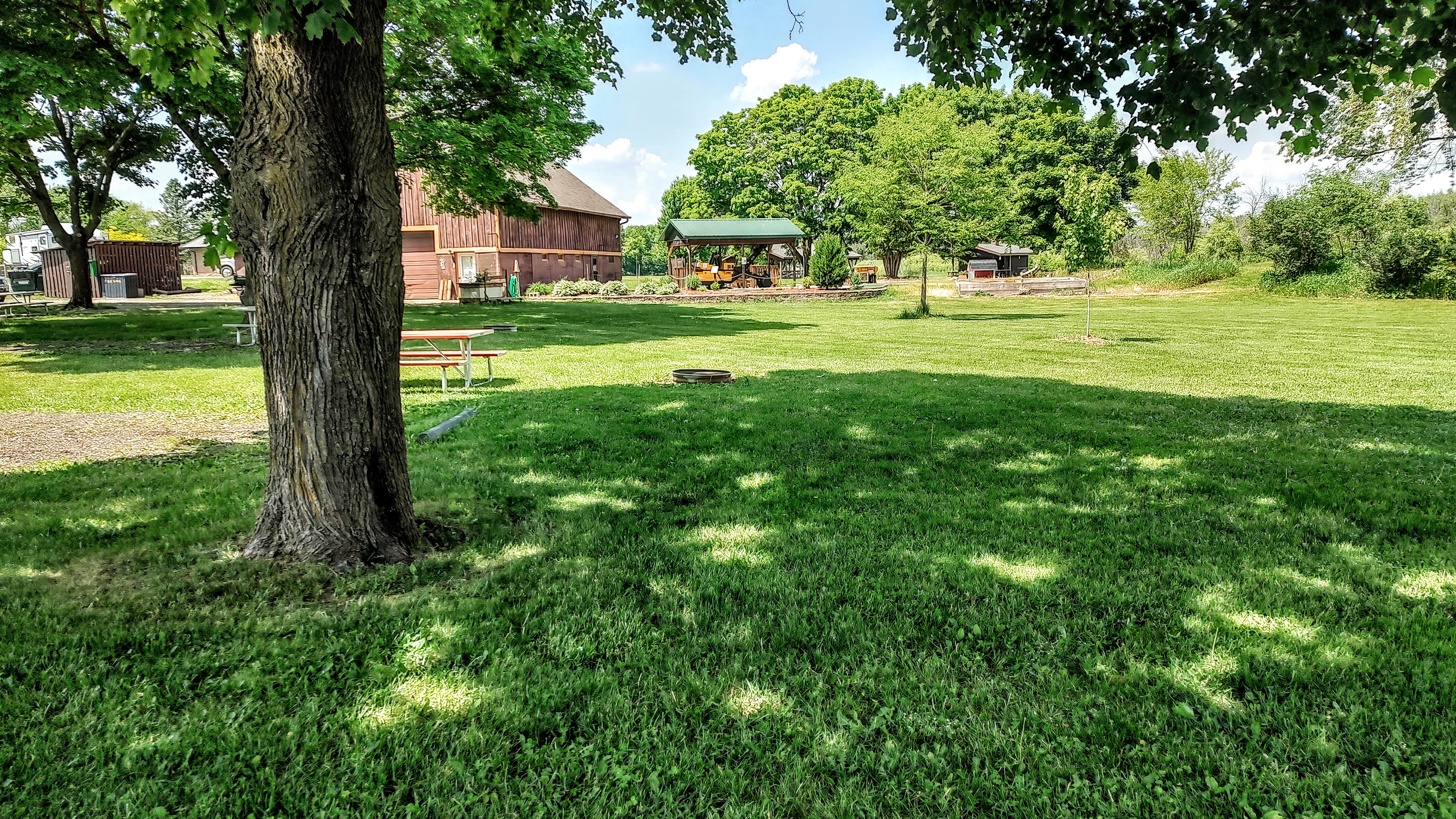
 For a small campground, 10 sites, there was a lot to do around the park. It offered mini-golf, disc golf, play area, large pavilion, kayaks, and fishing. Most of the Rvers that come here have families, and are weekend campers. Surprisingly it was not a drunken party fest during the weekend.


 think the deli sliced chicken breast is necessary, but I may replace it with bacon. The second try I added ricotta cheese to my recipe. I made two so that our sons family could try.